

Printing Property: The Risk and Opportunity in a 3D Printed World
he year is 2025, at a time when the majority of us haven’t been on a 3D printing construction site. How would a building be 3D printed? How does 3D printing work?
I want you to visualize the process of soft serve ice cream at a fast-food restaurant. The premixed ice cream is dispensed from a metallic head at a constant speed, while the server skillfully maneuvers his hand, circling the cone while lowering the position as the ice cream builds on top.
This analogy is in essence how 3D printing works: a malleable substance being dispensed layer by layer into specific shapes. In the ice cream example, the shape is a cone, and in the 3D printing building example, it is (usually) a vertical wall slab. One fundamental difference between making soft serve and printing a building lies in the relative locations of the dispenser and the nozzle. For the soft serve, the nozzle — the metallic head where the substance is dispensed — stays static, while the receiving cone makes the movement, calibrated to achieve the desired diameter, height, and shape. For the large-scale 3D printed building, the site stays static while a giant nozzle controlled by a 3D axis system conducts the movement, drawing a smooth line with premixed concrete, tracing along a predetermined path that over time, in a sedimentary manner, will become a monolithic mass.
Background
With the same 3D print job file, you can print from anywhere and from any machine, as long as it’s professionally calibrated with any kind of printing materials, ranging from corn-derived polylactic acid to highly engineered concrete, and at any scale, from a desktop miniature to a civic building block. The loss in translation of the geometry is minimal due to the coded pathway that dictates how it prints. With a 3D printer, you are free from the limit of having the expertise onsite, with no fear of miscommunication across teams or loss of information in the transition and translation between platforms.
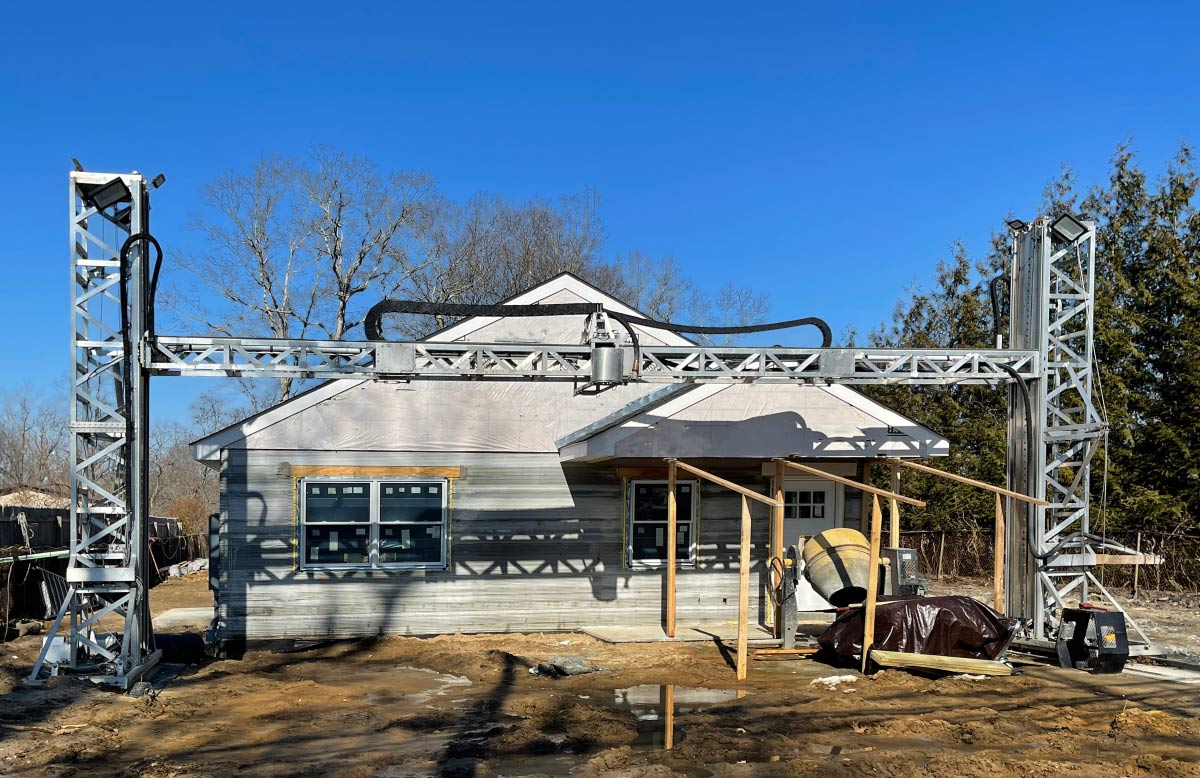
Overall, the scalability, duplicability, and humanless features make 3D printing extremely appealing to both investors and innovators around the world. Venture capitalists from San Francisco are funding start-ups in Texas (and other places in the U.S.2), while higher education institutions in the Netherlands3 and Switzerland4 are releasing groundbreaking innovations that make the technology more powerful every day.
As investors and innovators are making plans for expanding the endeavor, the insurance world has been relatively quiet on the subject. The aim of this article is to unpack this technology and initiate a discussion of the opportunities and risks of 3D printing as a construction method, especially as it impacts the property insurance market.
Buildings and insurance
While it was not discussed during the session, I wondered if this lack of synergy and urgency comes from the segregation among experts from different industries.
The evidence displayed at an actuarial conference for some building materials being safer than others is clear and sound. However, when it comes to choosing building materials, insurers don’t have much leverage to make the builder choose the construction materials. The risk profile of a building is determined by the design (the architect), the construction (the contractors), and the price (the suppliers). By the time the underwriter or the actuary is involved in the project, it’s too late. It usually isn’t until the house is near completion that the homeowners start to shop for insurance policies. Homeowners are also learning too late that they could have made different decisions that would have affected their coverages and prices.
When the major insurers in California withdrew from the homeowners market, it was largely due to the uninsurability of the houses in the wildfire-prone areas.6 Among the corporate evacuees, we see a strong trend among decisions made from 2021 and onward. Many major firms stopped issuing new policies, and some stopped renewals of property coverages in California. Many quoted the reasons being the increase in cost of construction and inflation.6
If the houses being built are too expensive to repair and replace, the conflict between insurance and construction boils down to the conflict between insurability and housing shortage. Both sides are doing what they have to do: insurers exit the market because it need to stay solvent; homeowners build in undeveloped wildfire-prone land because they run out of places to build.
When 3D printing enters the room
While investors and innovators are celebrating the cost efficiency and high fidelity of 3D printing buildings, insurers and regulators may find themselves advocating for this particular fabrication method for their own reason — risk reduction.
3D printing material for buildings is primarily concrete with reinforced rebars. Much like traditional concrete buildings, the material has similar fire resistance performance and isn’t easily destroyed by heat or smoke.7 A commercially available 3D exterior wall is claimed to have “a fire resistance rating of more than 2.5 hours per ASTM E119 and interior walls have a fire resistance rating of 117 minutes.”8
Apart from the reduced property damage side of the advantages, a 3D printed building may also eliminate certain liability risks during the construction process. Due to the minimal number of human workers on site, the insurance exposure is foreseeably reduced. The type of work is also much less risky than traditional construction, since humans are eliminated from tasks involving heights, heavy weights, or falling items. The most common task is to monitor the printing process, and the most likely injury risk is probably reduced to sunburn. Jokes aside, the cost of savings in workers’ compensation for developers and investors can be a significant incentive for the adoption of 3D printed buildings.
Another aspect, which is not directly linked to risks but should add more credibility to this construction method, is that it can be used for building. Since a printer can operate autonomously in conditions with unfavorable temperatures and no oxygen, governments and large tech companies are investing in experiments and projects to send printers to the moon to accomplish a task that is impossible for human astronauts to do.
The dark side of the moon
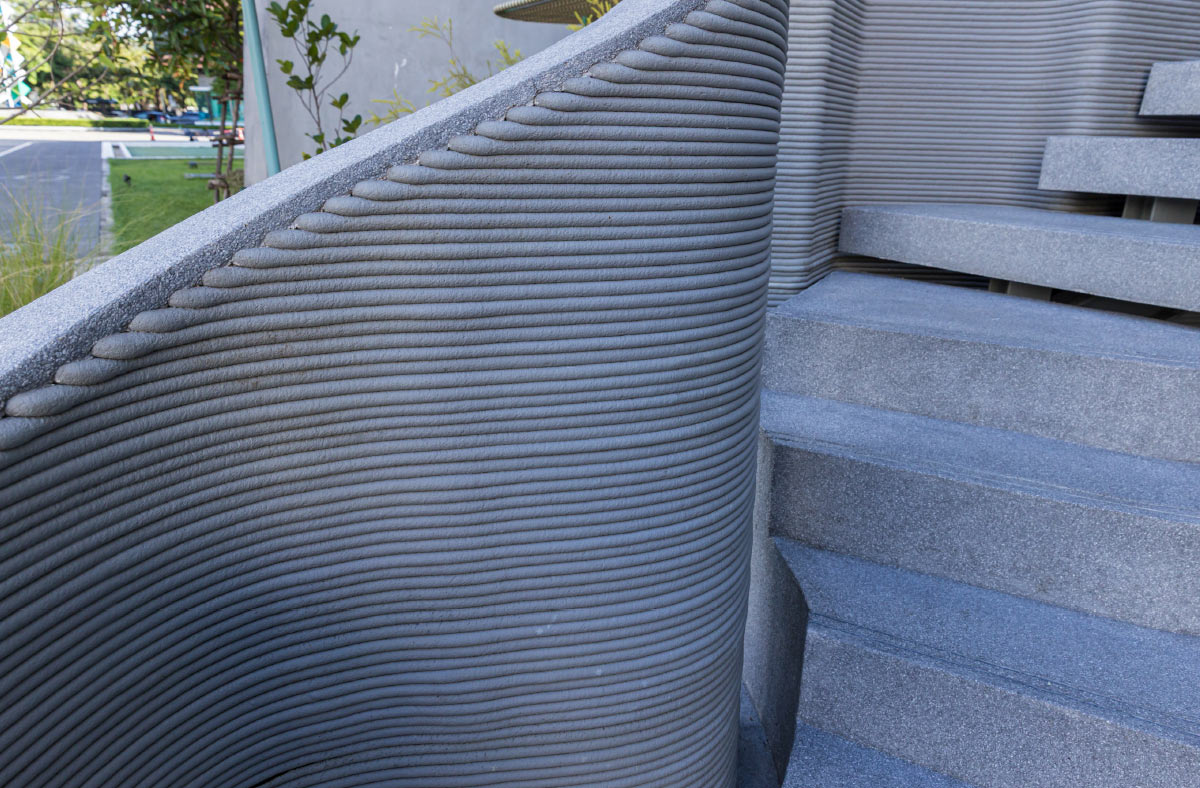
Because it’s printed from a refined nozzle and geometries are calibrated and optimized, a 3D printed wall will use significantly less concrete, making it more affordable and easier to construct than traditional concrete buildings. However, the reduced thickness increases the risk of brittleness, especially in terms of wind or earthquake resistance, but the actual impact will require more refined research.
Resistance against lateral force is another concern. Typically, current 3D printing technology fabricates in a sedimentary manner, producing layer after layer of material on a horizontal plane. To visualize this, recall the earlier soft serve ice cream analogy. What happens if your soft serve is built too high? It falls over, and you have less ice cream to enjoy. With sedimentary layers, tolerance of lateral force is weak. A 3D printed concrete wall is not as strong as a conventional concrete one, which has reinforced rebar that goes in both horizontal and vertical directions. To overcome such a shortfall, a comprehensive structural system is needed. Because of this weakness, existing 3D printing projects generally don’t exceed two floors because they lack reinforced vertical stability.
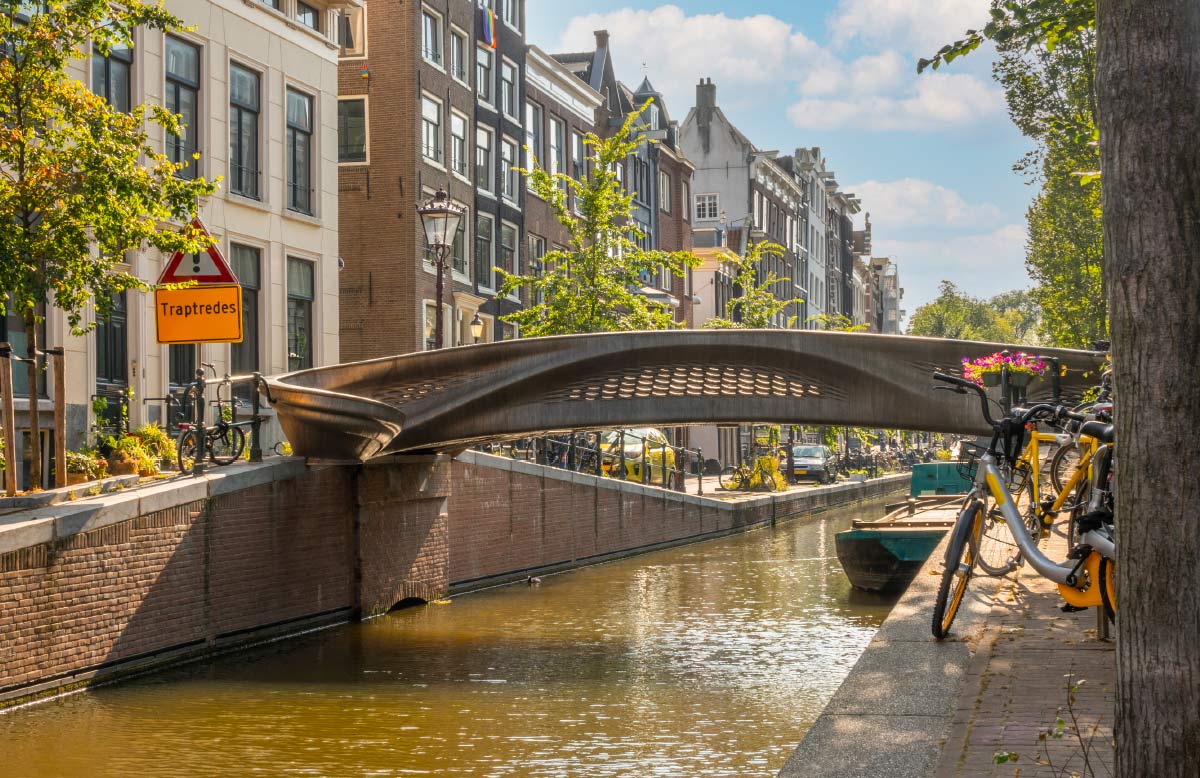
Risks aside, the technology itself has some hard thresholds to overcome. The 3D printing process is not strictly human less in any practical sense. The initial file creation requires an extremely high level of expertise. Knowledge about 3D modeling and the building’s construction are essential. Adding industrial experts to the staff of architects and designers will add costs to the project. Additionally, the starting stage of the actual printing process demands rigorous calibration, a process that takes in depth knowledge of the machine, as well as experience in troubleshooting. Most printing job failures occur at the beginning: rough or uneven platforms can jeopardize the rest of the print.
Once the file is created and the machine is calibrated, the rest of the process doesn’t involve a human’s touch. The general practice on a 3D printing site usually requires one engineer to “supervise” — that is, watch the printer in case anything abnormal happens: nozzle blockage, irregular extrusion of material, missing layer (due to nozzle blockage), etc. Such supervision is instrumental, especially for an open-air printing job (i.e., not in a controlled environment), and a mistake is consequential — it usually means hours of work and printed material is wasted, and if not caught early, the job may need to be restarted.
Speculation
Companies like ICON and Vertico are generating useful data and rapidly expanding the applications of 3D printing construction. Such total digitalization will change the landscape of data collection and analysis. We will have more accurate exposures, more timely reports on damage and cost, and more precise correlations between exposure and loss. It’s not science fiction that in a few years many of our constructions can be 3D printed, whether it’s motivated by cost saving, fireproofing, or the intricacies of construction. It’s our responsibility as risk professionals to understand what is coming toward us.
At a time when professionals are highly specialized in their own field, it’s unconventional and challenging to look at problems from other industries. I’ve seen amazing research done in vertical fashion, but it’s also important to look at problems horizontally. As insurance professionals, being curious about tangential knowledge that’s traditionally outside of our expertise will empower us to advocate for choices that serve us better collectively and will generate more synergy across boards. Collaboration and communication are the keys to open up solutions and new horizons for our field.
References
- History of 3D printing: It’s older than you think
- ICON, a pioneer in the 3D printing of homes, raises $56M led by Norwest, Tiger Global
- Vertico News
- Mechanics and Materials Laboratory — 3D Printing
- Wildfire Prepared: Practical, Proven Steps to Safeguard Homes and Communities, Alister Watt, CAS Annual Meeting, Austin, TX
- References:
- Fire performance of innovative 3D printed concrete composite wall panels — A Numerical Study, Thadshajini, Perampalam Gatheeshgar, Irindu Upasiri, etc.
- ICON Wall performance
- ICON Build — Story