







Contents

departments
- EDITOR’S NOTE
- Remembering 9/11
- President’s Message
- How I Spent My “Summer Vacation”
- Member News
- Comings and Goings
- Calendar of Events
- In Remembrance
- CAS Staff Spotlight
- Making Things Happen
- Meet the Veep
- One Conversation at a Time: How Aw Yong Chor Leong and ARECA Are Expanding the Actuarial Profession across Asia
- Professional Insight
- Developing News
- Professionalism Briefs
- Inside the CAS’s New Monograph on Exam 8
- Viewpoint
- Vibe Coding and the Next Silent Cyber Risk
- Solve This
- Forklift Clearance

on the cover
-
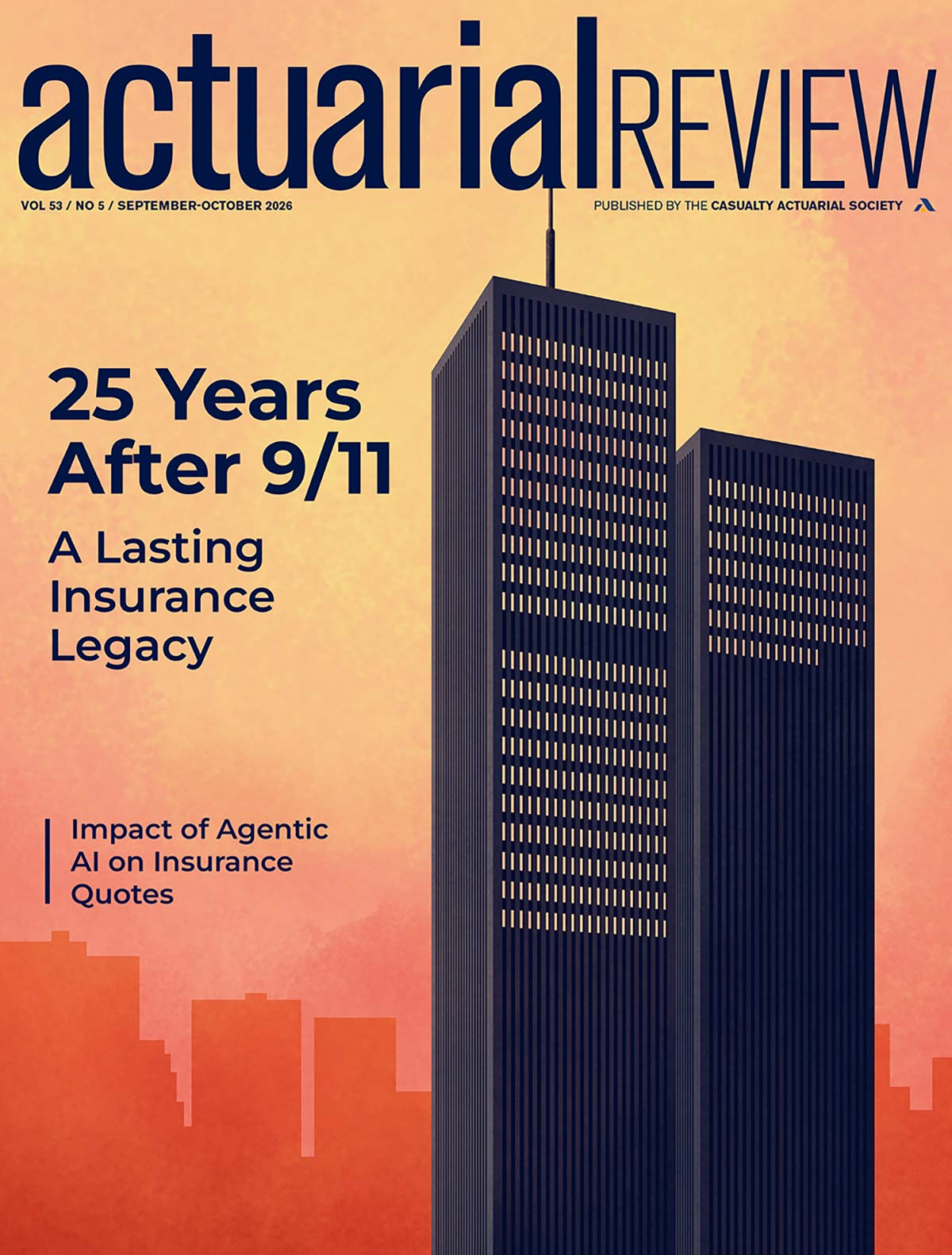
Jim Lynch presents a moving account of personal loss, professional resolve, and the lasting insurance legacy of a day that forever changed both the nation and the P&C industry.
-
Samiksha Padiyar explores how agentic AI empowers consumers to comparison shop, optimize quotes, and challenge claims like never before. This article explains how actuaries must rethink traditional approaches to pricing, reserving, and risk in an increasingly AI-driven marketplace.
The amount of dues applied toward each subscription of Actuarial Review is $10. Subscriptions to nonmembers are $50 per year. Postmaster: Send address changes to Actuarial Review, 4350 North Fairfax Drive, Suite 250, Arlington, Virginia 22203.
Masthead

-
Editor in Chief
Jim Weiss
-
CAS Director of Publications and Research
Elizabeth A. Smith
-
AR Managing Editor and CAS Editorial/Production Manager
Sarah Sapp
-
CAS Managing Editor/Contributor
Greg Guthrie
-
CAS Graphic Designer
Sonja Uyenco
-
CAS Cross-Functional Coordinator/Contributor
Delilah Barrow
-
News Editor
Sara Chen
-
Opinions Editor
Richard B. Moncher
-
Editors
- Colleen Arbogast
- Daryl Atkinson
- Karen Ayres
- Glenn Balling
- Robert Blanco*
- Lisa Brown
- Michael Budzisz
- Sumanth Chebrolu
- Nandina Chopra
- Todd Dashoff
- Daniel Jay Falkson*
- Stephanie Groharing
- Julie Hagerstrand
- Srinand N. Hegde*
- Cameron Herrmann*
- Kenneth S. Hsu
- Cindy Hu*
- Jack Huang*
- Rachel Hunter*
- Rob Kahn*
- Benyamin Kosofsky
- Julie Lederer
- Albert Lee
- David Levy
- James Li*
- Sydney McIndoo
- Stuart Montgomery
- Sandra Maria Nawar*
- Erin Olson
- Samiksha Padiyar
- Shama S. Sabade
- Michael Schenk
- Robert Share
- Craig Sloss
- Jared Smollik
- Andrew Somers*
- Bella Thiel*
- Isaac Wash*
- Radost Wenman
- Ian Winograd
- Vanessa Wu*
- Xuan You*
- Yuhan Zhao*
-
*Writing Staff
-
Puzzle
Jon Evans
-
Advertising
Al Rickard, 703-402-9713
arickard@assocvision.com -

The Casualty Actuarial Society is not responsible for statements or opinions expressed in the articles, discussions or letters printed in Actuarial Review. -
For permission to reprint material from Actuarial Review, please write to the editor in chief. Letters to the editor can be sent to AR@casact.org or the CAS Office. To opt out of the print subscription, send a request to AR@casact.org.
Images: Getty Images -
© 2026 Casualty Actuarial Society.
ar.casact.org
Remembering 9/11
ome stories are remembered through headlines. Others are remembered through the people who lived them. This issue is dedicated to 534 insurance industry professionals lost during 9/11, denoted on the cover by window lights for each.
Our cover story by Jim Lynch revisits 9/11 through the recollections of actuaries whose lives were forever changed — those trapped in the World Trade Center, those stranded at the CAS Casualty Loss Reserve Seminar in New Orleans, and those waiting anxiously for loved ones to return home. It tells a deeply human story of uncertainty, resilience, and loss. At the same time, the story traces how the attacks reshaped the insurance industry, from record-breaking claims and landmark litigation to the creation of terrorism insurance and a hard market that influenced the profession for years to come. It’s a remarkable example of how personal experiences and industry advancement are inseparable, reminding us that behind every catastrophe are individual lives and behind every industry response are people determined to move forward.
This story offers more than a retrospective. It is a reminder that the actuarial profession has always been called upon to make sense of uncertainty in the wake of unimaginable events. While the decisions made in the months and years that followed 9/11 continue to influence the insurance marketplace today, the personal stories shared here ensure that the human impact is never overshadowed by the numbers. We hope this article honors both the profession’s response and the lives forever changed by that day.
This issue invites you to step back into a moment that changed history and to see it through the eyes of those who experienced it firsthand. Their memories, combined with the industry’s response, offer an important reminder of why this story requires retelling 25 years later.

Actuarial Review
Casualty Actuarial Society
4350 North Fairfax Drive, Suite 250
Arlington, Virginia 22203 USA
Or email us at AR@casact.org

How I Spent My “Summer Vacation”
nother school year is upon us, and somewhere, even if only in my imagination, elementary school students are writing essays on how they spent their summer vacation. As an elementary school student, my essay likely would have included references to daily games with neighborhood friends — sandlot baseball, touch football, kick the can, and flashlight tag, to name a few. Rainy days would have meant reading, playing checkers, chess, and card games with my older brother, or watching educational television — you know, shows like “Batman,” “Get Smart,” and “Gilligan’s Island” — whatever was airing on one of the five or six available channels. I’m sure there would also be some family gatherings mentioned, along with a week or two at my grandparents’ home on their little lake in Indiana.
As a recently retired adult, my essay would still include lots of activities with neighborhood friends, like golf, hiking, pickleball, tennis, playing music, boating, hiking, fly-fishing, cycling, game nights, etc. It would also have some “adulting” activities, like painting (rooms in the house, not art), planting, trimming, cleaning, and all the other “benefits” of being a homeowner. Then there would be family gatherings at the lake, watching my grandchildren’s activities, and simply spending time at home. Rainy days would have involved reading, playing cards or board games with my wife, cleaning, paying bills, and, when I chose to watch some “educational” television, a lot more available channels!
This year, I would also have had the opportunity to describe some of the interesting activities and travel that come with being CAS President — the CAS Spring Meeting in New York (along with employer meetings with Aon and Verisk), the International Actuarial Association meeting in Slovenia, the CAS International General Insurance Teaching Summit in Bangkok, the Canadian Institute of Actuaries Annual Conference in Calgary (along with a side trip to Banff), a speaking engagement at CNA Insurance’s Actuarial & Data Sciences meeting in Chicago, the CAS Board retreat in Greenville, South Carolina (my adopted home town), and an Asia tour that included visits with actuarial organizations and educators in Singapore, Taipei, Shenzhen, and Qingdao.
2026 CAS Student Central Summer Program
CAS International General Insurance Teaching Summit
Actuarial Research Conference

Gamma Iota Sigma (GIS) Leadership Symposium
International Association of Black Actuaries (IABA) Annual Meeting
Organization of Latino Actuaries Avanza Conference
Asian Actuarial Conference (AAC) 2026
CAS/AICT Joint Property/Casualty Actuarial Seminar
SUSTech Enterprise Management Session
2026 CAS China Insurance Summit
In addition to these highly visible activities, the CAS held its annual elections, offered numerous webinars and professional education opportunities, oversaw multiple exam sittings, and moved into a new office space in Arlington, Virginia. All in all, it was a busy and successful “summer vacation.” Thank you to all the CAS staff and volunteers who continue to offer outstanding opportunities to candidates and members throughout the year!
Actuarial Review Letters Policy
Letters shall not contain personal attacks or statements directly or implicitly denigrating the characters of individuals or particular groups; false or unsubstantiated claims; or political rhetoric. Letters should be no more than 250 words and must include the author’s name and phone number or email address, so the editorial staff can confirm the author. Anonymous letters will not be published. There shall be no recurrence of topics; issues previously addressed will not be the subject of continued letters to the editor, unless new and pertinent information is provided. No more than one letter from an individual can appear in every other issue. Letters should address content covered in AR. Content regarding the CAS Board of Directors or individual departmental policies should be directed to the appropriate staff and volunteer groups (e.g., board, working groups, committees, task forces, or councils) instead of AR. No letter that attempts to use AR as a platform for an ulterior purpose will be published. Letters are subject to space limitations and are not guaranteed to be published. The AR editorial volunteer and staff team reserves the right to edit any submitted letter so that it conforms to this policy. Decisions to publish letters and make changes to submissions shall be made at the discretion of the AR Working Group and CAS staff.
For more information on AR editorial policies, visit here.
Comings and Goings
Kendra Felisky, FCAS, has been appointed chair of the boards of Arch Insurance (UK) Limited and Arch Managing Agency Limited by Arch Insurance International. Felisky has more than 20 years of experience across actuarial, risk management, and board governance roles. She combines extensive independent non-executive director experience across the insurance sector with a strong executive track record, having been one of the leaders of the general insurance actuarial practice at Deloitte and having served as chief risk officer at Travelers.
Derek Martisus, ACAS, has been appointed partner, alternative risk and national captive leader at Conner Strong & Buckelew. Martisus brings more than 22 years of experience in captive solutions, having worked with clients across all major U.S. captive domiciles, as well as in the Cayman Islands and Bermuda. He most recently served as senior vice president at Marsh McLennan Agency, where he focused on single-parent and group captive solutions. In his new role, he will collaborate with colleagues across the organization to help clients control insurance costs and strengthen risk management programs.
Anthony Katz, FCAS, FSA, MAAA, has been appointed senior vice president of reserving at Fortegra. In the role, Katz will oversee Fortegra’s actuarial reserving function, leading a team responsible for reserving operations, credit insurance, statistical reporting, and key regulatory and accounting initiatives, including IFRS 17 implementation. Katz joins Fortegra with extensive experience across reserving, pricing, financial reporting, and actuarial operations, having held senior leadership positions at several major insurance and consulting organizations.
Lizzie Eason, ACAS, has been appointed director and actuarial data scientist at WTW within its pricing, product, claims, and underwriting (PPCU) consulting team in North America. Eason brings nine years of insurance carrier experience, including strong expertise in actuarial and data science, predictive modeling, and machine learning. She most recently served as principal data scientist at Everest and as a data science consultant at Nationwide. In her new role, Eason will support PPCU clients and prospects by developing integrated consulting and technology solutions, with a focus on predictive modeling, advanced analytics, and AI.
Maja Dos Santos, FCAS, joined the executive leadership team as senior vice president and chief risk officer at Wawanesa Mutual. Dos Santos joined Wawanesa in 2003 and has held roles of increasing responsibility across actuarial functions and enterprise risk management.
Julia Vul, FCAS, has been appointed vice president, corporate actuarial, and appointed actuary for Wawanesa Mutual. Vul has more than 20 years of actuarial and insurance industry experience. Vul’s appointment as appointed actuary places her in a position carrying statutory weight under Canadian federal insurance regulation.
Samuel Garvey, FCAS, has been appointed commercial lines analytics practice leader at HUB International Limited. Garvey will help develop proprietary tools and processes that strengthen how HUB analyzes risk and advises clients on program structure, retentions, loss projections, and total cost of risk. He will collaborate with HUB’s commercial lines teams to embed position analytics as a lever to support new business and client retention and equip producers with data-backed insights.
Marc Grandisson, FCAS, MAAA, has been appointed executive chairman of Vantage Group Holdings Limited. Grandisson is the former CEO of Arch Capital Group Limited, which he joined in 2001. He served as chairman of the Association of Bermuda Insurers and Reinsurers from 2021 to 2022. Prior to ACGL, he worked for Berkshire Hathaway, F&G Re, and Towers Watson. Grandisson is a minority investor in the NHL’s Carolina Hurricanes and the NBA’s Portland Trail Blazers.
Joe Liang, FCAS, has been appointed executive chairman of Greater China for reinsurance at Aon. Liang brings more than 34 years of insurance industry experience to help advance Aon’s capabilities and deliver insights that support better business decisions for clients. Liang previously held senior leadership positions across underwriting, reinsurance, risk management, and actuarial functions in China and the U.S., including executive roles at SAIC Insurance Limited and Ping, a P&C insurance company. He is a fellow of the Chinese Actuarial Society.
Calendar of Events
-
November 8–11, 2026
2026 CAS Annual Meeting
Honolulu, HI -
December 3, 2026
2026 CAS Canada Connection
Montreal, Quebec, Canada -
March 15–17, 2027
Ratemaking, Product and Modeling Seminar
Indianapolis, IN -
May 16–19, 2027
2027 CAS Spring Meeting
Chicago, IL -
June 1–3, 2027
Seminar on Reinsurance
Hamilton, Bermuda


In Remembrance
An Actuary and Volunteer
1955–2025
Cynthia Potts, FCAS, passed away in December 2025. Born in Montreal, Potts’s early education began at The Study, a private, non-subsidized, bilingual school for girls, and continued at Lawrence Park Collegiate Institute when her family moved to Toronto. She graduated from Queen’s University in Kingston in 1978 with a degree in mathematics, launching a career that would see her become a consulting P&C actuary and a partner in one of Canada’s largest independent actuarial consulting firms. When Potts achieved fellowship in the CIA and the CAS in 1986, she became only the sixth woman in Canada to hold both distinctions. After graduation, Potts began her actuarial career at the Royal Insurance Company in Toronto. In 1988, she moved into consulting at MLH+A, focusing on P&C insurance. She joined Eckler in 1993, becoming a leader in the firm’s P&C practice until her retirement in 2021. Potts specialized in appointed actuary work for some of Eckler’s largest clients, mentored junior colleagues, and served as the chief architect of Eckler’s valuation and financial condition testing software for P&C clients. Potts was known for her warmth, generosity, and infectious laughter. She was a cherished wife, sister, aunt, and friend, always thinking of others and offering support when needed. Her passions included curling, bridge, baking, travel, and spending time at her cottage in Haliburton and her villa in Nevis in the Caribbean. She was a devoted “dog mum” and a dedicated volunteer baker for North Toronto churches, helping those in need. Potts is survived by her husband, Nigel; her siblings, David, Katherine, and Julie; as well as several nieces and nephews. She leaves behind a legacy of kindness, leadership, and service that will be remembered by all who knew her.
The Philanthropic Mathematician
1939–2026
Carole Jeanne Banfield, née Michaels, passed away in June 2026. Born on December 15, 1939, and raised in Albany, New York, Banfield lived a remarkable life defined by intellect, generosity, devotion to family, and a deep appreciation for the arts and community. She was a longtime resident of Warren, New Jersey, from 1991 until 2024, and spent the past two years living in Basking Ridge, New Jersey. Banfield was the daughter of Ulysses and Carolyn Michaels. From an early age, her brilliance and determination were evident. She graduated as valedictorian of St. Joseph’s Academy in Albany before attending Fordham University, where she earned her bachelor’s degree in mathematics. During her time at Fordham, she was one of only two women in the mathematics program, an extraordinary accomplishment during that era. It was also there that she met her future husband, Joseph Henry Banfield. The two began as college lab partners, building a partnership that would grow into a loving marriage and lifelong companionship. Banfield enjoyed a distinguished and highly respected career in the insurance industry, spanning more than six decades. Through her intelligence, leadership, and dedication, she rose through the ranks from assistant actuary to executive vice president of Verisk Analytics, formerly ISO, a position she assumed in 1996. Widely admired throughout the industry for her expertise and professionalism, Banfield played an instrumental role in the development of insurance data management and actuarial services nationwide. She led ISO’s government relations department, worked closely with state and federal regulators, and was deeply involved in the development and implementation of many of the organization’s principal insurance programs. Following the events of September 11, 2001, she spearheaded efforts to obtain regulatory approval for terrorism-related insurance policy language and testified at numerous regulatory hearings throughout her career. Banfield will be remembered for her extraordinary intelligence, generosity, elegance, warmth, and unwavering love for those around her. Her legacy lives on through the countless lives she touched, both personally and through her philanthropic work.
The Professor
1942–2026
Janice Rose Zemanek Cutler passed away in February 2026, in Palatine, Illinois. Cutler was born in Chicago to Ludwig and Mary Zemanek. Her family later moved to a dairy farm in Deerbrook, a small town in central Wisconsin. There, she grew up surrounded by family, living with her parents, paternal grandparents, twin sister Janet, and younger siblings Kenny and Ellen. Janice and her siblings attended the one-room Little Chicago Grade School on County Road V. She excelled in all subjects, showing a particular aptitude in mathematics. She earned a full scholarship to the University of Wisconsin–Madison and graduated in 1964 with a bachelor’s degree in mathematics. She received her doctoral degree from the University of Illinois Urbana-Champaign in 1969. Janice served as an assistant professor of mathematics at Louisiana State University from 1970 to 1976. It was at LSU where she met her husband of 52 years, William “Bill” Cutler. They were married in Antigo, Wisconsin, on August 12, 1973. Janice applied her mathematical expertise to the insurance industry, beginning a successful career in 1978 as an actuarial assistant for Wausau Insurance in Wausau, Wisconsin. In 1985, she and Bill moved to Palatine, Illinois, where she worked at Zurich Insurance in Schaumburg through 1999 and then as an actuarial consultant for John Pierce from 1999 to 2008. Ultimately, Janice returned to the classroom, serving as an adjunct professor in the mathematics department at Harper Community College in Palatine, Illinois, from 2005 to 2020. She is survived by her devoted husband, Bill; her daughters, Barb Cutler (Derek Bruening) and Beth (Stefan) Lowe; and her cherished grandsons, Felix Lowe (6) and Tristan Lowe (3). She is also survived by her twin sister, Janet Dixon; her brother, Kenneth (Ann) Zemanek; and her sister, Ellen (Robert) Christenson.

CAS Staff Spotlight
Meet Pete Van Dyke, Certification Program Manager

Peter Van Dyke
elcome to the CAS Staff Spotlight, a column featuring members of the CAS staff. For this spotlight, we are proud to introduce you to Pete Van Dyke.
- What do you do at the CAS? How does your role support the Strategic Plan?
I’m one of the two certification program managers on the Admissions team. I work with our exam team volunteers to develop our exam items and ensure that our exams are fair, valid, and legally defensible. This collaboration enhances the candidate experience and provides accurate measurement of candidate experience, education, and expertise. - What inspires you in your job? What do you most love about your job?
The generosity of our volunteers who donate their time and expertise to make our certification program world-class is a constant inspiration. Most of all, I love working with my CAS teammates, who bring professionalism, innovation, and fun to the job. - Describe your educational and professional background. What do you bring to the organization?
My career began in law enforcement, transitioned to education and training of police officers, and eventually to certification and assessment. I like to think that I bring a unique customer service perspective to the organization while never forgetting to ask how decisions will affect our candidates. - What is your favorite hobby outside of work?
Spending time with our two dogs who couldn’t be more different (one is an insecure, 90-pound German Shepherd, and the other a hyper-protective, 11-pound Havanese). I previously volunteered as half of a therapy dog team and hope to resume that work in the near future. - If you could visit any place in the world, where would you go and why?
I’d love to visit Japan. I spent 25 years training and teaching Japanese and Okinawan martial arts and would love to learn more about the people and places responsible for the things that had such an influence on me. Oh, and the food! - What would your colleagues find surprising about you?
I really enjoy cooking and learning to make new dishes…but I am terrible at it! - How would your friends and family describe you?
A happy introvert who knows a little bit about a lot of things, and a lot about a little.


Making Things Happen
Behind the Balance Sheet: Daniel Jaeger Helps Build a Stronger CAS

Daniel Jaeger
ost members experience the CAS through conferences, publications, continuing education, and the value of the credential in their professional life. Few stop to think about the people working behind the scenes who ensure those experiences remain relevant, financially sound, and positioned for the future.
Daniel Jaeger, FCAS, CFA, has spent his volunteer career gaining a unique perspective on both the member-facing and operational sides of the Society. From helping organize educational conferences to overseeing investment strategy and financial stewardship, his volunteer journey has reinforced one central lesson: The long-term success of the CAS depends on dedicated volunteers who contribute their expertise in ways members may never see.
“I’ve become much more aware of what it takes to maintain the value of our credentials,” Jaeger said. “The respect the CAS designation receives from employers, regulators, clients, and the public doesn’t happen automatically. It requires ongoing work from both volunteers and staff.”
Like many CAS volunteers, Jaeger’s involvement began with a simple step — completing the Volunteer Interest & Participation (VIP) survey.
His first assignments placed him on the planning committees for the Casualty Loss Reserve Seminar and Seminar on Reinsurance. At first, he viewed the opportunity as a chance to give back while meeting other actuaries. Beyond that, he gained a much deeper appreciation for everything that goes into producing a successful professional event.
“Serving on those committees made me realize how much I had taken for granted as a conference attendee,” he said. “Before volunteering, I didn’t fully appreciate everything that goes into organizing a multiday event — from coordinating general and breakout sessions to planning the flow of the event.”
Selecting timely topics, recruiting engaging speakers, and coordinating dozens of moving pieces requires months of planning and collaboration. Jaeger found that recruiting subject matter experts, while sometimes challenging, was always rewarding because of the valuable relationships it fostered. In particular, the Seminar on Reinsurance committee grew into a close-knit group whose members developed lasting professional connections while working toward a common goal.
One of Jaeger’s favorite memories was organizing a session on marine and energy insurance. He secured two outstanding speakers and structured the session to link their expertise while delivering his own presentation on recent industry loss events.
Those early volunteer experiences demonstrated something that has been confirmed time and again throughout his CAS service: volunteering not only strengthens the organization but also broadens the volunteer’s own perspective.
After serving on conference planning committees, Jaeger intentionally pursued opportunities that would expose him to operational aspects of the Society.
“I — and I’d wager most members — have never really stopped to think about the CAS’s finances,” he said. “How are revenues trending? How is surplus managed?”
Seeking answers to those questions led him into finance leadership roles, first as chair of the CAS Investment Council and now as Assistant Treasurer, where he helps oversee many of the Society’s financial functions. The transition gave him an entirely new appreciation for the organization.
Instead of focusing on a single conference or initiative, he began thinking about how financial decisions support every aspect of the CAS — from education and member services to strategic investments that ensure the Society remains strong for years to come.
Although finance may not receive the same visibility as educational programming or member events, Jaeger believes it is essential to everything the CAS accomplishes.
“Like any organization, the CAS has to responsibly manage budgets, cash flow, and capital,” Jaeger said. Through the combined efforts of staff and volunteers, those activities help ensure the Society’s long-term financial health.
His philosophy of stewardship extends beyond balancing budgets. To Jaeger, responsible financial management means making thoughtful decisions that allow future generations of actuaries to benefit from a strong professional organization.
“I really like how the CAS manages itself for the long term,” he said. “It doesn’t make knee-jerk reactions. Instead, it makes thoughtful decisions that consider the actuaries of today and tomorrow.”
One memorable insight came through his work with the CAS Investment Council. “I found it particularly interesting to watch the parallels between the CAS’s investment philosophy and insurers’,” he said. “When interest rates sharply increased during 2022, both the CAS and insurers quickly took advantage of attractive overnight risk-free rates because both had some level of conservatism embedded in their investment appetites.”
Serving in multiple volunteer roles has fundamentally changed how Jaeger views the CAS. As a member, it’s easy to see conferences, publications, and professional education as separate offerings. As a volunteer, he has come to appreciate how interconnected those efforts really are. He says conference committees create opportunities for members to learn, collaborate, and build relationships that strengthen the profession. Behind those programs, finance and investment leaders ensure those programs remain sustainable, While staff and volunteers work together to protect and enhance the value of the CAS credentials. Taken together, these efforts advance the Society’s mission in ways that many members may never fully realize.
The experiences have given him an even greater appreciation for the volunteers whose work often happens quietly behind the scenes. Keeping members connected — to one another and to the Society — requires continued creativity and commitment from volunteers.
While volunteering has allowed Jaeger to contribute to the Society, it has also contributed significantly to his own professional development.
“It has been a tremendous networking opportunity,” he said. “I’ve worked alongside people with different backgrounds, perspectives, and leadership styles. Learning from those experiences has been valuable both professionally and personally.”
His advice for members considering volunteering is “Don’t wait — just get involved.” He encourages members not only to complete the VIP survey but also to be proactive if they have a particular interest.
“If you don’t immediately land the role you’re hoping for, reach out directly to someone involved in an area that interests you,” he said. “Showing initiative and expressing genuine interest can go a long way. Opportunities will materialize if you stay engaged.”
Away from actuarial work, Jaeger enjoys amateur woodworking and tennis — two hobbies that provide a welcome change of pace from analytical thinking. “When you’re in the middle of a cut on the table saw or focused on a tennis point, there’s not much room for your mind to wander,” he said. His next woodworking project is building a set of birch plywood Montessori shelves for his baby son.
Meet the VEEP
Melissa Huenefeldt, VP, Professional Education

Melissa Huenefeldt
hen Melissa Huenefeldt attended the CAS’s Course on Professionalism before earning her ACAS, she couldn’t have known she was taking the first step on a volunteer journey that would eventually lead her to become vice president of Professional Education.
During a lunch break, one of the course facilitators explained that the CAS is truly a volunteer-led organization and encouraged her to get involved. Huenefeldt remembers making a promise that day: “As soon as I earn my ACAS, I’m going to volunteer.”
She kept that promise. Today, Huenefeldt provides strategic leadership for one of the Society’s most far-reaching activities, overseeing professional education programs that support members throughout every stage of their careers. Her path reflects not only a deep commitment to the profession but also the tremendous impact dedicated volunteers have on the CAS and its members.
As vice president of Professional Education, Huenefeldt works with the Professional Education Council and its working groups to ensure members have access to relevant, high-quality educational opportunities long after they complete their credentialing exams. Her responsibilities include supporting continuing education initiatives, overseeing professionalism education, collaborating with volunteer leaders, and helping guide policies related to lifelong professional development.
“My goal is to ensure that CAS members have meaningful educational opportunities at every stage of their careers,” she says. “I want professional education to be relevant, engaging, and practical while maintaining the high standards our profession is known for.”
That mission reflects how the actuarial profession continues to evolve. Today’s actuaries are expected not only to provide technical expertise but also to lead teams, communicate effectively, navigate ethical challenges, and influence strategic business decisions. Professional education is evolving alongside those expectations.
One initiative Huenefeldt is particularly excited about is expanding leadership education. As more CAS members move into executive leadership, C-suite, and board positions, educational offerings are growing to help prepare actuaries for those opportunities.
The Professional Education Council is also emphasizing the importance of continuing education attestation. As a self-regulated profession, publicly affirming compliance with continuing education requirements helps maintain public trust, and the council is working with the Member Engagement team to develop educational campaigns that reinforce that message.
Another priority is keeping the Course on Professionalism fresh and relevant. Because that course launched Huenefeldt’s own volunteer journey, she is especially excited to see the curriculum evolving to remain engaging and meaningful for future generations of actuaries.
Although much of the council’s work happens behind the scenes, its impact reaches members throughout their careers — from the Course on Professionalism to continuing education and the CAS’s major educational events, including the RPM Seminar, Spring Meeting, Reinsurance Seminar, CLRS, and Annual Meeting.
When asked what makes her most proud, Huenefeldt doesn’t point to a specific initiative. She points to the volunteers.
“Our volunteers bring incredible expertise, enthusiasm, and dedication,” she says. Watching them collaborate, mentor one another, and create meaningful educational experiences continually reminds her of what makes the CAS unique.
She especially enjoys watching volunteers grow into leaders. Seeing members join a working group, take on increasing responsibility, and eventually lead initiatives themselves reinforces the strength of the CAS volunteer community and gives her confidence in the Society’s future.
help shape an important milestone in candidates’ actuarial journeys.”
“Working with Melissa is great,” says Nora Potter, CAS director of Professional Education. “I always come out of discussions with her feeling as though they are productive and gaining greater insight into the profession.”
Along the way, volunteering became much more than an opportunity to give back. “It gave me the opportunity to work alongside incredibly talented actuaries, build lasting professional relationships, develop leadership skills, and help shape an important milestone in candidates’ actuarial journeys,” she says.
Professionalism and education have always been passions for Huenefeldt. While technical expertise remains essential, she believes successful actuaries also need strong communication, leadership, and professional judgment. Leading Professional Education allows her to help members build those skills.
That broader approach mirrors the profession itself. As actuaries increasingly serve as strategic advisors and business leaders, continuing education has expanded beyond technical topics to prepare members for a wider range of responsibilities.

While in graduate school, she landed her first actuarial position before taking her first actuarial exam. One story from that time has become a favorite. She defended her master’s thesis and took Exam FM on the very same day. She passed the thesis. Passing the exam would have to wait until the second attempt.
Professionally, she began in personal lines pricing for a regional insurer before spending 13 years with a global insurance brokerage, where she eventually led a team of analysts. Five years ago, she joined Milliman as a consulting actuary, where she enjoys solving a wide variety of client challenges across multiple industries.
For members interested in volunteer leadership, Huenefeldt offers this advice: “Don’t focus on the title; focus on contributing.” Volunteer for work that genuinely interests you, follow through on your commitments, and be someone others enjoy working with. Leadership opportunities, she says, tend to follow naturally.
Outside of work, Huenefeldt is an accomplished marathon runner. She recently completed her 31st marathon in her 22nd state as she and her sister work toward running a marathon in all 50 states. She sees striking similarities between marathon training and the actuarial profession: neither is about overnight success. Both require persistence, determination, and the willingness to keep moving forward one step at a time.
Those same qualities have defined Huenefeldt’s volunteer journey. She has shown how sustained volunteer service can shape both an individual’s career and the future of the profession. As the needs of CAS members continue to evolve, Huenefeldt and the volunteers she leads are helping ensure that Professional Education grows and evolves with them.
One Conversation at a Time: How Aw Yong Chor Leong and ARECA Are Expanding the Actuarial Profession across Asia

Aw Yong Chor Leong
hen Aw Yong Chor Leong, FCAS, known to most as “CL,” talks about volunteerism, he rarely begins with numbers.
Yes, there are impressive statistics. More than 750 attendees participated in Asia Region Casualty Actuaries’ (ARECA’s) 2025 webinar series. More than 40 university teams from 21 institutions competed in the Peak Re–sponsored ARECA Case Competition. CAS leaders have recently visited more universities, regulators, employers, and actuarial organizations across multiple countries. Meanwhile, educational workshops, networking events, and student outreach continued to expand throughout the region.
But Leong prefers to talk about outcomes that are harder to measure: The conversations after an event has officially ended, the student who discovers that general insurance can be a career in actuarial science, the volunteer who reluctantly agrees to organize a seminar only to discover a passion for leadership, and the friendships that form across countries, cultures, and time zones.
Those moments, he believes, are what have transformed ARECA from a regional affiliate into one of the CAS’s most vibrant communities.
Building a community across borders
Unlike many CAS volunteer groups concentrated within a single country, ARECA operates across a vast geography encompassing different countries, multiple languages, diverse cultures, varying educational systems, and many insurance markets.
That reality changes how volunteerism works.
“In many ways, we were just continuing what ARECA set out to do from the start — bringing people together, sharing knowledge, and building something that lasts,” Leong wrote in his farewell message as ARECA president.
Rather than relying primarily on committees or formal meetings, ARECA volunteers build relationships market by market. Local representatives bring deep knowledge of their own countries, while collaborating with colleagues throughout Asia to create programs that can be adapted across the region.
The result is volunteer work that is simultaneously local and international.
A university presentation in Kuala Lumpur may inspire ideas for an event in Hong Kong. A networking reception in Singapore leads to collaboration with volunteers in Taiwan. A speaker from Germany presents to attendees from dozens of cities in Asia.
Every event becomes an opportunity to strengthen the regional network.
Volunteerism that meets people where they are
Instead of expecting members to travel frequently, ARECA has embraced a flexible model that blends virtual education with strategically placed in-person events. Volunteers organize activities in their own cities while sharing resources, speakers, and expertise across borders.
This approach has allowed a relatively small group of volunteers to deliver an outsized impact.
Over the past year, ARECA delivered a six-part webinar series covering topics from parametric insurance and IFRS 17 to pricing, professionalism, and open-source actuarial tools, providing continuing education to more than 750 attendees across Asia.
The organization has also developed networking events, university outreach programs, technical workshops, AI education sessions, professionalism seminars, and collaborations with local actuarial associations throughout the region.
These activities often happen because volunteers simply raise their hands.
“So, if you’ve been reading this newsletter thinking, ’That looks like something I’d enjoy,’ — you’re probably right,” Leong wrote. “You don’t need to be the most technical person in the room. You don’t need to have all the answers. You just need to start.”
Growing the next generation
Now in its seventh year, the Peak Re–sponsored CAS ARECA Case Competition introduces university students to real-world property and casualty insurance problems while connecting them directly with practicing actuaries.
The 2025 competition attracted more than 40 teams, representing 21 universities across Malaysia, Singapore, Australia, Hong Kong, mainland China, Indonesia, Nepal, Taiwan, and Vietnam. Students researched the impact of electric vehicles on the insurance industry before presenting their work to panels of experienced CAS members.
For many participants, the competition serves as their first meaningful exposure to general insurance actuarial work.
The competition is just one part of a broader educational strategy that includes university visits, student networking events, hackathons, campus information sessions, scholarship opportunities, and presentations about the CAS credentialing pathway. Throughout the year, ARECA volunteers visited universities across Asia to introduce students to careers inP&C and connect them with practicing actuaries.

Bringing the CAS to Asia
Over the past year, CAS presidents, ambassadors, staff, and volunteers traveled to Taiwan, mainland China, Pakistan, Hong Kong, the Philippines, Singapore, and Malaysia, meeting with regulators, insurers, universities, employers, and actuarial organizations.
The visits go beyond delivering presentations.
Volunteers answer students’ questions about exams, career paths, and professional development. They meet with regulators to discuss emerging issues such as climate risk and IFRS 17. They visit employers to better understand regional workforce needs. They participate in local conferences while sharing global perspectives on actuarial practice.
Each visit strengthens relationships that continue long after their flights home.
Recognition earned through service
Leong’s own contributions have not gone unnoticed. In 2024, he received the CAS New Members Award for his volunteer contributions to ARECA and the Asia Regional Working Group. The award recognizes members who have made significant volunteer contributions within five years of earning their most recent credential. Even while accepting the recognition, Leong emphasized that volunteerism is less about individual achievement than collective effort.
“There were no barriers, and we were all treated equally and fairly,” he wrote. “You could be in the C-suite of a large corporation or a student from a university, but as a CAS volunteer, we are all the same.”
That philosophy has become one of ARECA’s defining characteristics.
A model for global engagement
Through collaboration, flexibility, and a willingness to meet members where they are, volunteers have built an organization that develops future actuaries, supports practicing professionals, strengthens relationships with regulators and universities, and expands the CAS’s presence throughout Asia.
The measurable achievements are substantial. The less measurable ones may prove even more lasting. Students discover careers they had never considered. Volunteers become leaders. Professional relationships evolve into friendships that span countries and cultures.
As Leong reflected at the conclusion of his presidency, the greatest opportunity for ARECA’s future does not lie in another program or initiative — it lies with the next volunteer willing to get involved.
“Don’t wait to be invited,” he wrote. “Raise your hand. Show up.”


Impact of Agentic AI on Insurance Quotes
I adoption has increasingly been a topic of conversation among insurance professionals. While the primary focus has been on how companies can utilize AI in their offerings to better their product and simultaneously increase workplace efficiency, it is important to consider the shift that increased customer adoption of AI will bring about in the insurance marketplace. Although most industry professionals are familiar with generative AI, customer use of agentic AI is a much bigger transformation than most insurance companies might be prepared for.
Unlike generative AI, agentic AI works like an assistant assigned an overarching goal that breaks down tasks. These tasks may include browsing online shopping websites to find the best price for a pair of your favorite boots or acting as a customer service representative. Most importantly, agentic AI is able to learn as it completes tasks, course correct if it runs into issues, and tweak its process to make it increasingly easier to execute. It also incorporates memory capabilities, enabling it to redo repetitive tasks multiple times (Stryker 2026). These features mean that customers now have the power to use agentic AI to simplify multiple insurance tasks, like request online quotes, submit claims, and dispute claims.
Generic uses of agentic AI
Gemini recently rolled out their “Auto Browse” feature, making it easier than ever to automate repetitive tasks (Tabriz 206). This feature, utilizing agentic AI, is able to carry out routine tasks by taking control of and opening multiple browser tabs to accomplish a specified goal. This feature is built-in and incorporated for free into everyone’s Chrome browsers, and as of June 2026, Google has rolled out this feature to all consumers (Reid 2026). While the free version of this feature has usage limits, Google includes the upgraded version of Gemini Pro with their yearly 5TB storage plan, which costs about $200 a year (Google 2026). With this ease of access, customers have already reported using Gemini Auto Browse to track order statuses, quickly and efficiently fill out forms, and do their online shopping for them (u/NecessaryBear98 2026). Agentic AI also has multiple uses for insurance customers, in both quote generation and claim filing.
Using AI to test pricing engines: A simple experiment
With my options finalized, I asked AI to build out every single test case scenario to input into the engine with various combinations of the fields I could change. In my testing, I also used two customers — one included all my information, and the other profile was built around my boyfriend. Ultimately, within two minutes, I had Gemini output about 1,900 iterations, out of which I asked it to pick 50 iterations that could lead to the lowest quote, half with my profile and half with my boyfriend’s. Within seconds, Gemini had generated a spreadsheet that I could use in my agentic AI testing (see Figure 1).
Figure 1.

Figure 2.

Table 1.

Figure 3.


The use of agentic AI removes the barriers of time and effort that typically dissuades customers from shopping around for the best price and exposes insurers to a heightened risk of adverse selection. Customers could potentially manipulate their profiles in two ways: by outright fraudulent tweaking of annual mileage inputs or by optimizing their job descriptions to pick an ambiguous but technically truthful profession. Both scenarios create an information imbalance that current rating algorithms are not prepared to handle. Simultaneously, pricing actuaries will need to adapt to a market where even a 5% price increase over a competitor’s pricing could lead to a customer switching policies. To stay competitive, actuaries might need to start keeping a closer eye on competitor movements, keeping in mind thousands of bots running in the background to find the customer the lowest price for their insurance policies. Additionally, actuaries might also need to track how AI-assisted shopping affects premium trend over time, since that is a key input into rate indications. As customers rely on increased automation to drive down their premiums, actuaries might need to account for premium drift, which would produce a lower premium trend than would be historically expected.
Using AI to test policy loopholes
Additionally, there is now legal precedent to allow discovery of insurer systems to analyze whether AI was used to possibly unfairly deny claims, like in the case of the Estate of Gene B. Lokken v. UnitedHealth Group, Inc. (Bracken II and Niczky 2026). This could mean that while insureds can use AI to potentially identify if they can sue their insurer, the latter needs to be very careful about their use of AI in any part of the process. If an insured and their legal team can prove that a claim was denied without human review, it could expose the insurer to a host of bad-faith claims lawsuits. Additionally, with growing public outrage regarding the use of AI to approve or deny claims, insurance companies could face online backlash and, in a worst-case scenario, be embroiled in a public relations crisis.
Regardless of the verdict, a lawsuit means that insurers see longer claim settlement timelines, higher legal costs, and greater uncertainty about ultimate losses and severity metrics. With the rise in social inflation, we are seeing higher verdicts if the case goes against an insurer, as evidenced by courtroom severity more than doubling from 2020 to 2024 (Kansky and Manrique 2026). AI might further exacerbate this trend by enabling law firms to take on more cases at lower costs, making it easier for insureds to pursue litigation, and driving up the number of insurance lawsuits. To top it all off, third party litigation funding (TPLF) is also making it more enticing for insureds to go down the courtroom path rather than settling out of court. With investors looking for profit instead of trying to make the insured whole, the settlements coming out of these cases are in the tens of millions of dollars, if not hundreds of millions (Lynch 2025). With all these factors at play, reserving actuaries need to actively reassess trend picks, tail factor selections, and estimated case reserves to keep up with the impact of AI on reserving practices.
What does this mean for actuaries?
References
Bruno, Tamara D., and Shareen Sarwar. “AI and Insurance Policy Interpretation After Snell v. United Specialty: What Policyholders Need to Know.” Policyholder Pulse, 25 February 2026, https://www.policyholderpulse.com/ai-insurance-policy-snell-united-specialty-policyholders-need-know/. Accessed 15 June 2026.
Google. “Google AI Plans.” Google One, https://one.google.com/intl/en/about/google-ai-plans/. Accessed 15 June 2026.
Kansky, Jessica, and Juliana Manrique. “From Headlines to the Jury Box: Assessing the Impact of Nuclear Verdicts on Litigation.” US Law, 2025, pp. 8-9. US Law, https://www.uslaw.org/wp-content/uploads/2025/09/From-Headlines-to-the-Jury-Box-Assessing-the-Impact-of-Nuclear-Verdicts-on-Litigation_Verdict-Insight-Partners_Fall2025-USLAW-Magazine.pdf. Accessed 15 June 2026.
LawPay. “AI for Law Firms: What the 8am Legal Industry Report Tells Us About AI Use.” American Bar Association, 1 April 2026, https://www.americanbar.org/groups/law_practice/resources/law-practice-magazine/2026/march-april-2026/8am-legal-industry-report/. Accessed 15 June 2026.
Loktionova, Margarita. “How AI Tools Influence the Modern Buyer Journey: A Survey of 1,000+ US Consumers.” Semrush, 5 March 2026, https://www.semrush.com/blog/ai-tools-the-modern-buyer-journey-study/. Accessed 12 May 2026.
Lynch, Jim. “Financing Justice: The Rise and Risks of TPLF.” Actuarial Review, 16 July 2025, https://ar.casact.org/financing-justice-the-rise-and-risks-of-tplf/. Accessed 16 June 2026.
Reid, Elizabeth. “Search’s I/O 2026 updates: AI agents and more.” Google Blog, 19 May 2026, https://blog.google/products-and-platforms/products/search/search-io-2026/#agentic-coding. Accessed 15 June 2026.
Stryker, Cole. “What is Agentic AI?” IBM, June 2026, https://www.ibm.com/think/topics/agentic-ai. Accessed 15 June 2026.
Tabriz, Parisa. “The New Era of Browsing: Putting Gemini to Work in Chrome.” Google Blog, 2026, https://blog.google/products-and-platforms/products/chrome/gemini-3-auto-browse/. Accessed 12 May 2026.
u/NecessaryBear98. “I Tried Gemini Chrome Auto Browse And Chrome Got Scary Useful.” Reddit, May 2026, https://www.reddit.com/r/AISEOInsider/comments/1tfzjjh/i_tried_gemini_chrome_auto_browse_and_chrome_got/. Accessed 15 June 2026.
The CAS AI Primer
- Provide a concise overview of AI concepts and applications relevant to actuarial work.
- Highlight potential risks and outline best practices for responsible AI use.
- Outline key corporate and regulatory considerations that shape AI implementation in actuarial contexts.
- Direct readers to trusted learning resources for building deeper AI literacy and practical skills.
Twenty-Five Years After 9/11: A Lasting Insurance Legacy
After 9/11
Insurance
Legacy
hil Miller, FCAS, always called home when he finished his morning commute to lower Manhattan. This time he would report something extraordinary but troubling. An airplane had smashed into the building next to his own.
He said he would come home soon.
That morning, 1,300 miles away in New Orleans, actuaries gathered in a ballroom at the Fairmont Hotel for day two of the Casualty Loss Reserve Seminar. During a session on “Issues and Trends with Asbestos,” moderator Mike Angelina, FCAS, announced to attendees that a plane had hit the World Trade Center.
Many people assumed it was a tiny plane, perhaps a pilot who had lost control after a heart attack. That was unusual but not unprecedented. A B-25 had struck the Empire State Building in 1945; 14 had died.
Angelina gave his talk, followed by Kevin Madigan, ACAS, who spoke for about 25 minutes.
After that, normality went on hiatus.
CAS employee Emily Monacell came onstage to announce that the rest of the seminar was canceled. The New Orleans airport was closed. Anyone who had checked out of the hotel would be able to check back in.
Madigan remembers:
We were all very confused. Someone in the audience who apparently had a BlackBerry or something similar (this [being] pre-iPhone era) said, “tell them what’s going on,” at which time the staff member burst into tears. She regained composure, or tried to, and said, “America is under attack!”
The day, of course, was September 11, 2001. Things that had been stable were no longer. Things happened that shouldn’t have. Tall buildings shouldn’t crumble in minutes, but they did. Presidents shouldn’t have to hopscotch across the country to find safety, but ours did. Governments should be able to protect us from the worst, but ours had not.
People who go to the office in the morning should work and then leave, but that day thousands didn’t.
This is a story about people wanting to go home.
It is also a story about insurance. The P&C industry paid around $40 billion in 9/11 claims. At the time, it was the worst-insured catastrophe. It remains the worst man-made catastrophe.
It remains the worst catastrophe for workers compensation, business interruption, and aviation insurance, too, despite an enormous compensation program that relieved airlines and their insurers of billions of dollars in liability.
It triggered an extraordinary lawsuit that changed how insurers operate.
It created a new coverage — terrorism insurance — and a federal backstop to nurture a marketplace for the coverage.
9/11 changed everything.
For Miller, leaving the World Trade Center was taking far longer than it took to get in. Just a few minutes earlier, a series of elevators had whisked him to the 103rd floor. Now he was trudging down a staircase with some Aon colleagues.
He wasn’t supposed to be at work that day. He had planned to work from his family vacation cabin in the Poconos, a privilege earned after more than 30 years as a fellow and insurance executive. Miller had risen to a senior vice president at Insurance Services Office before moving to Aon in the mid-1990s.
But he had forgotten a few things at work, so he’d ferried over from Staten Island and most likely walked the final mile. And now he was making his way down from Aon’s 103rd floor offices with maybe a half-dozen colleagues.
Even though Miller’s building, the South Tower, had been declared secure, most people on the higher floors were leaving. Overcrowded stairwells stalled everyone’s descent. Phil’s group decided to switch to the elevators.
[We] stopped … on the 78th floor — the sky lobby, where all the elevators met. … Then Phil left. … Just after he walked away, there was a tremendous explosion. The marble walls crumbled. All the lights went out. I was thrown across the lobby. This is the end, I thought. I should’ve walked down.1
The second plane had struck the South Tower, its left wing plunging through the sky lobby. Wein found one colleague dead and one with his legs broken. She was able to walk down to safety.
She didn’t know what happened to Phil.
The actuaries in New Orleans felt no immediate danger, but they were surrounded by uncertainty and turmoil.
Madigan:
Some of the attendees at my session left, but most just sat there shocked. Those who had smartphones or laptops started using them to find out what was going on.
Doug Oliver, FCAS, had been scheduled to speak after Madigan.
Madigan:
[Oliver] stood up and said something to the effect of “you heard her, you can leave or stay. You can’t fly anywhere, but I guess you could go get drunk on Bourbon Street. So, you may as well stay and listen to me.” And then he proceeded with his presentation, which ran about 20 minutes long.
In his defense, there was nothing else going on and he did tell everyone to leave if they wanted. Might as well talk about reserving to pass the time. Some did slowly trickle out, but most people stayed till the end. I think we were all in shock.
Most of the 583 attendees eventually made their way to the International Ballroom on the mezzanine level. It was the natural gathering point; breakfast, lunch, and session breaks were all held there.

Madigan:
She blurted out “I don’t know if any of my colleagues are still alive” and kept sobbing … Lots of people from metro New York were furiously scrambling to find out if their loved ones were affected … CAS staff were all trying to figure out if their loved ones and colleagues in the D.C. area were safe. It was scary. I and many others were trying to make sure our loved ones far from the events knew we were OK.
Attendee Richard Carris, then a claims expert for Ernst & Young, was at the seminar to talk about the new way the National Association of Insurance Commissioners wanted claim expenses to be classified — DCC and A&O replacing ALAE and ULAE. As he took in the tumult in the New Orleans ballroom, he also thought about the insurance behind the chaos in New York.
Carris:
All were stunned, and we realized … this was not an accident. Being a claims dude, I recall very well making a comment and question: … Was this going to be one or two occurrences in the world of property insurance?
The Twin Towers were separate buildings but part of a single complex — six buildings on an enormous plaza. Everything was obliterated when the towers fell.2
A public body, the Port Authority of New York and New Jersey, built the complex in the early 1970s. In summer 2001, the Port Authority leased the towers and two other plaza buildings to a private company, Silverstein Properties. Silverstein’s team assembled $3.55 billion of coverage from 22 insurers.
Less than six months later, the towers had fallen. The plaza was destroyed.
One claim or two? There were two attacks, but the attacks were coordinated. And two buildings were struck, but the buildings were part of the same complex.
Carris:
Of course, two occurrences would mean double the limit of insurance.
Further complicating matters, there was insurance but no insurance policy. Negotiations for the Silverstein Properties lease had been protracted. Coverage was bound, but final wording hadn’t been set.
Two forms were circulating. One defined “occurrence” specifically. The other defined it broadly or lacked any definition.3 Six years and a series of lawsuits later, Silverstein Properties would get $4.55 billion — $1 billion above the single-occurrence limit.4
Carris:
That day, somehow Joseph Treaster from The New York Times was able to get through to me on my cellphone — he wanted to quote me and, specifically, if I thought insurers would be invoking the war exclusion in property insurance.
It looked like war — coordinated attacks on America’s financial and political center. The next day, President George W. Bush said they “were more than acts of terror. They were acts of war.”
Carris demurred.
Robert Hartwig, then chief economist at the Insurance Information Institute (Triple-I), got similar calls, even as he was watching the detritus of the buildings billow skyward from his office three blocks away.
Hartwig:
So I made a judgment call that that the war exclusion would not apply here. First of all, there had been no declaration of war. Second of all, the industry had paid in past terrorist events. [Terrorists had blown up a truck in a garage beneath the World Trade Center in 1993.]
The next day’s Wall Street Journal quoted him: “It’s not clear if some or all of the insurers had such exclusions.”6
In New Orleans, Pat Teufel, FCAS, had planned to talk about a new Standard of Practice (Property/Casualty Loss and Loss Adjustment Expense Reserves), but she never got the chance.

I mean … disbelief … How can this be happening? … Everybody at the conference was gathered in that room … fixated on the screen.
Certainly after the second plane went down, my first thought was … I’ve got to call my husband [in Connecticut, where he taught] and tell him I’m OK.
He taught fifth grade [in West Hartford, Connecticut], and you know, you don’t interrupt a teacher in a classroom. So I called the office. And I said to just get him a message that I’m OK.
He got the note, and they didn’t have anything running in the classroom, needless to say … So he didn’t know. He’s like, what on earth is she sending me this message for?
And the office staff said, well, there’s a lot happening.
But … then for me, the meeting turned into: … How do we get back to our loved ones?
Most attendees had flown to New Orleans, but the FAA grounded all flights nationwide at 9:26 a.m. It wasn’t clear when they would resume. No one wanted to hop onto what could become a hijacked missile.
Teufel:
No one knew whether it was a one-and-done event or whether there would be [more] attacks. The airlines were certainly not running. I wasn’t going to get on a plane for sure.
Trying to leave New Orleans proved difficult, Teufel said. “You called any [car] rental company and they weren’t renting.” People lucky enough to have rented a car before September 11 just drove it home.
“The rental cars that were out,” she said, “were not coming back.”
People could wait a day or two for a car, or they could get creative.
Peter Royek, ACAS (“Introduction to Reinsurance Reserving”), was in New Orleans with seven other people: his parents, wife, two children, and two close British friends. He visited a rental desk at a nearby Marriott, with no luck.
Walking through the Fairmont lobby, he heard that someone had chartered a bus and two drivers to Philadelphia, which was not terribly far from his home in Rockaway Township, New Jersey.
He snagged the final seats, rounded up his family and friends (the kids were at the pool), and scurried onto the bus.
Carris, the claims guy, walked a mile to Amtrak’s Union Passenger Terminal. The only train to his home in New York, the Crescent, had left at 7 a.m. Wednesday’s train was canceled; Thursday’s was booked.
But the claims guy was also a trains guy. He knew that Amtrak always held an accessible sleeper compartment but would sell it to anyone if it was still available a day or so before. That’s how he got home.
Madigan snagged a rental car the next day:
I started calling all the local rental car places in New Orleans. The national numbers were all telling me that officially none of the locations were operating. The person I spoke to on the national Avis line said she had heard some locations were open, but you had to call them directly. I managed to get a hold of someone at the Avis counter at the New Orleans airport around lunchtime on the 12th and was able to reserve [a Chevy Cavalier].
Teufel rode home in a rental car with three other people. “It wasn’t me who organized it,” she said. “As I recall, there were four of us” traveling in “a typical sedan … We were just looking to get out.”
Trips home are memorable because how little of them is remembered. After the torrent of events Tuesday morning, little remains vivid in the minds of the actuaries who were among the hundreds of thousands of people pulsing along superhighways in America’s darkest night, a reverse white-collar diaspora.
Madigan doesn’t recall stopping for dinner, “though surely we did.”
Teufel remembered eating at a Waffle House, maybe, but not the sequence of highways that got her back to Connecticut.
Stopping for gas in Knoxville, Tennessee; in Roanoke, Virginia. Getting dropped off at the Quaker Bridge Mall in Lawrenceville, New Jersey.
They caught a stretch limo home.
“Considering the events of that day,” Royek said, “our journey was an inconvenience, not a tragedy.”
By the evening of September 11, Phil Miller’s daughter, Sheryl Miller Bechor, was riding north from Florida on Interstate 95, back to her childhood home on Staten Island.
She was on the road with family — a cousin, her husband, and her children, both under age 3. Her dad loved to play with kids, but he had only been able to spend a little time with them.
Sheryl had a cellphone and free minutes — someone at the phone company understood her plight. She was calling morgues, hospitals, anyone who might know what had happened to her father. Despite the destruction that TV had shown that day, there were stories of miraculous survivors — precious few but often told. Could her father have been one of those?
The van stopped in North Carolina for the night. Sheryl remembers how helpful people were. She remembers driving beneath overpasses, seeing people holding American flags.
The group arrived at the Staten Island homestead; there were no more hospitals to call, no more morgues to check.
Sheryl gave a DNA sample for the medical examiner’s office, a cheek swab.
Financial losses from 9/11 were enormous. The attacks produced catastrophic losses on lines of business that had never had one before. The largest insured catastrophe up to then had been $16 billion for Hurricane Andrew in 1992.
Writing a year later, Triple-I economist Hartwig cited 9/11 losses at $40 billion, including $2.7 billion in life insurance claims (see Figure 1).7

Managing insurance claims often involves a search for proximate cause, the “but for” moment that made what happened unavoidable, if not inevitable.
It is hard not to consider the aviation industry as the proximate cause of 9/11. In 2001, the airlines were responsible for passenger screening, “the most important and obvious layer of security.”8
From the 9/11 Commission report:
As the Inspector General of the Department of Transportation told us, there were great pressures from the air carriers to control security costs and to “limit the impact of security requirements on aviation operations.” A longtime FAA security official described the air carriers’ approach to security regulation as “decry, deny and delay.”
That contention was never tested in court. Within two weeks, Congress developed an $18 billion bailout that capped carrier liability for 9/11 and future attacks. In its place, Congress created the September 11 Victim Compensation Fund, which distributed $7 billion to victims and their families.9
Even so, U.S. P&C insurers lost $7 billion that year, the first year the industry lost money since at least 1975. Industry underwriting losses topped $50 billion.10
Madigan:
In the fall of 2001, the January 1, 2002, renewal season was crazy as there was a lot of uncertainty about reinsurance capacity. I spent the four weeks between Thanksgiving and Christmas pricing renewals for a client that was inundated with submissions. This was indirectly related to 9/11, as the specific work was not related to the attacks, but the volume of work was driven by all the market uncertainty created by the attacks.
With higher rates and less capital to support risks, insurers could be selective. The single exposure no one wanted to write was terrorism.
Before 9/11, the largest insured terrorism loss had been $900 million, the 1993 bombing of the NatWest Tower in London.12
The 9/11 attacks were unprecedented, sudden, and devastating. No one knew whether further attacks might be looming.
The biggest fear was a dirty bomb: explosives encased in radioactive material that would kill hundreds, maybe thousands, and render the surrounding area uninhabitable for years, a Chernobyl-like radioactive zone radiating out from, say, Times Square.
By 2002, 45 states and the District of Columbia allowed insurers to exclude terrorism from most P&C coverage. Insurers excluded terrorism everywhere they could. So-called trophy properties — sports arenas and landmarks that seemed to invite the evil terroristic eye — couldn’t find coverage.
But some coverages couldn’t exclude terrorism. Workers compensation, of course, covers injuries arising out of and occurring in the course of employment, regardless of cause.
This patchwork of problems found a political solution. Congress passed the Terrorism Risk Insurance Act (TRIA). It required insurers to offer coverage but created a complex government backstop to cover extreme events. TRIA was temporary, but it has been regularly renewed. The latest version is due to expire at the end of 2027, but legislation to renew has been filed in Congress.13
Two major insurance brokerages operated from the World Trade Center on 9/11. Aon lost 176 employees that day. Guy Carpenter lost 23, counted among the 358 Marsh McLennan employees and consultants who perished.
Phil Miller is believed to be the only FCAS who died. There was a memorial service but no funeral, because there were no remains.
The calls came sporadically to Bechor’s phone. The medical examiner would call after each new DNA match. It happened every few months for 10 years. Finally, his daughter told them to stop calling; it was too hard to relive.
Call again, she said, when they find his wallet or his wedding ring.
Something to remember him by.
- Judy Wein and Cheryl Rhodes, “The Survivor from the 103rd Floor,” Ladies’ Home Journal (New York, United States), December 2001.
- World Trade Center 7 was a separate commercial development across the street. It collapsed around 5 p.m. EDT.
- Meg Green, “Three Insurers Win Ruling That WTC Disaster Was One Event,” Best News & Research Service (Oldwick, NJ), September 25, 2002, https://news.ambest.com/newscontent.aspx?refnum=52954&altsrc=174.
- Rodd Zolkos, “‘Wilprop’ Case Changes the Industry; WTC Occurrence Dispute Teaches Some Tough Lessons,” Business Insurance, September 12, 2011.
- “Insurance Circular Letter No. 20 (2008): All Insurers, Reinsurers and Insurance Producers | Department of Financial Services,” accessed May 2, 2026, https://www.dfs.ny.gov/industry_guidance/circular_letters/cl2008_20.
- Christopher Oster, et al., “Insurers May See Biggest Liability Ever for Losses,” Wall Street Journal (New York), September 12, 2001.
- Robert P. Hartwig, “The Impact of the September 11 Attacks on the American Insurance Industry,” in Patrick M. Liedtke and Chrisophe Courbage, eds., Insurance and September 11: One Year After (The Geneva Association, 2002), https://www.genevaassociation.org/sites/default/files/publications-document-type/pdf_public/sys_insurance-and-september-11-one-year-after.pdf. Estimates vary considerably; careful readers will notice that in the chart the dollar breakdown from the destruction of the Twin Towers is $1 billion too low.
- National Commission on Terrorist Attacks, The 9/11 Commission Report (2004), p. 101 https://9-11commission.gov/report/.
- Elaine McArdle, “Kenneth R. Feinberg: ‘I’m Very Proud of What We Did,’” Harvard Law Today, September 9, 2021, https://hls.harvard.edu/today/kenneth-r-feinberg-im-very-proud-of-what-we-did/.
- R. Glenn Hubbard, et al., “The Economic Effects of Federal Participation in Terrorism Risk,” Risk Management and Insurance Review 8, no. 2 (2005): 177–209.
- Judy Greenwald, “Hard Market Likely to Last through 2003,” Business Insurance, September 1, 2002, https://www.businessinsurance.com/hard-market-likely-to-last-through-2003/.
- R. Glenn Hubbard, et al., “The Economic Effects of Federal Participation in Terrorism Risk.”
- Congress Senate, “S. 4395 (IS) – Terrorism Risk Insurance Program Reauthorization Act of 2026,” Government, Govinfo.Gov, U.S. Government Publishing Office, April 27, 2026, https://www.govinfo.gov/app/details/BILLS-119s4395is.
Chad Hemenway, “Update: House Committee Advances Bill to Extend Federal Terrorism Backstop,” Insurance Journal, January 22, 2026, https://www.insurancejournal.com/news/national/2026/01/22/855197.htm.

Developing News
Concentration by Construction: The Accumulation Risk Hiding in the AI Data Center Boom

he build-out of data centers, motivated by the scaling needs of AI, has become a rapidly growing exposure in property and casualty insurance. S&P Global Ratings called it a “meaningful growth opportunity” in an April report,1 projecting that rising demand for data center insurance coverage could generate $10 billion in new premiums in 2026, and the Swiss Re Institute’s March Sigma report estimated that global premiums linked to data centers could more than double to $24 billion by 2030.2 The opportunity is clear, but the hard question is whether insurers can see how much of that exposure may move together.
That question starts inside the facility. A modern data center relies on shared power, cooling, and fire-suppression systems. Swiss Re, citing FM Global data, noted that fire accounted for only 10.9% of data center loss events but 42.3% of loss costs over a 15-year period. Liquid cooling, adopted to manage the heat from dense AI chips, adds another path for loss if water escapes near sensitive equipment, and a power or cooling failure can leave the building intact but idle the economic value inside it.
Data centers also cluster geographically. Large facilities need reliable power and fiber connectivity, sufficient land, and a viable cooling strategy, narrowing the pool of suitable locations. Swiss Re estimates that more than one quarter of U.S. data center capacity may be in areas with at least three large hail days annually, while about 40% may sit in significant-to-very-high tornado day zones. A single tornado path can damage multiple structures on one campus — and in some cases multiple campuses — through wind, debris, or wind-driven water intrusion, creating losses that exceed what a single-location maximum probable loss estimate may capture.
A less visible form of concentration may sit on the asset side of the balance sheet. In its March Quarterly Review, the Bank for International Settlements observed that off-balance-sheet financing structures channeling private credit into AI-related data center infrastructure “strengthen links between hyperscalers4 and non-bank investors such as private credit vehicles and insurers.”3 For an insurer that both writes the property risk and invests in credit tied to the same build-out, risk could become correlated across underwriting and invested assets.
What this means for actuaries:
- https://www.spglobal.com/ratings/en/regulatory/article/data-centers-offer-a-hyperscale-pool-of-insurable-risks-s101669146.
- https://www.swissre.com/institute/research/sigma-research/sigma-insights-07-2026-insuring-ai-data-centre-risks.html.
- https://www.bis.org/publ/qtrpdf/r_qt2603u.htm.
- Large cloud service providers such as Amazon, Alphabet, Microsoft, etc.
Developing News
AI Costs Have Token Stage
he promise of AI to skyrocket productivity and profitability has driven companies across industries to encourage employees to incorporate AI into their daily work. But are companies ready to face the cost?
Since the beginning of the year, organizations adopting AI at scale have already confronted shockingly high expenditures. For example, Uber employees burned through their entire annual Claude Code budget by April.1 Another company reportedly incurred half a billion dollars in Claude usage fees in a single month.2 Now, some companies are scaling back their AI initiatives and reprioritizing human productivity in an effort to be more cost-effective.3
To mitigate rising AI costs, AI providers such as Anthropic are moving toward usage-based cost models, where companies pay based on how many AI “tokens” employees use. For example, asking ChatGPT to perform a simple arithmetic calculation may use up to 500 tokens. However, more complex tasks, such as generating a chunk of code, may use more than 10,000 tokens.4 Basically, the deeper AI has to “think,” the higher the cost. Most people would agree this is a fair pricing model, but large organizations with complex data and countless models can see costs add up quickly.
Excessive AI costs aren’t the only emerging problem. Chipotle’s publicly available web chatbot was recently hijacked by hackers who used its tokens to generate Python code.5 Although a seemingly harmless scenario, this signifies an emerging risk of third-party token misuse, as organizations must now consider how excessive AI costs may arise from parties other than their own employees. Additionally, this highlights the importance of AI governance and how critical it is to examine vulnerabilities that AI may introduce throughout an organization’s digital ecosystem.

What this means for actuaries:
Step 1: Identify exposure amount
Estimated usage: 50 million tokens per month for 12 months
Total exposure = 600 million tokens per 12 months
Step 2: Develop base rate
Selected base rate = $1.25 per million tokens
Considerations include expected loss from AI errors, legal and regulatory risk, and operational risk.
Step 3: Apply risk factors
Public chatbot = +40% (higher risk than internal-use model)
Higher-reasoning AI model = –25% (less error)
Strong risk controls = –20% (strong governance)
Healthcare industry = +30% (higher liability)
Step 4: Premium calculation
Base premium = 600M tokens × $1.25 / 1M = $750
Net factor = 1.40 × 0.75 × 0.80 × 1.30 = 1.092
Final premium:
$750 × 1.092 = $819/year
- https://fortune.com/2026/05/26/uber-coo-ai-spending-tokens-claude-code/.
- https://finance.yahoo.com/sectors/technology/articles/one-company-spent-half-billion-183000167.html.
- https://fortune.com/2026/05/22/microsoft-ai-cost-problem-tokens-agents/.
- https://iternal.ai/token-usage-guide.
https://help.openai.com/en/articles/4936856-what-are-tokens-and-how-to-count-them.
https://prompt.16x.engineer/blog/code-to-tokens-conversion. - https://gizmodo.com/should-you-hijack-a-corporate-ai-chatbot-for-free-tokens-2000767595.
https://developers.openai.com/api/docs/pricing.
Developing News
A Decade-Low Combined Ratio for P&C Insurance: Analyzing the Drivers Behind the Results
he P&C industry closed out 2025 with a net combined ratio of 92.9%, the lowest since 2006. Additionally, 2025’s net underwriting gain of $63 billion was nearly triple the $23 billion gain in 2024 and $22 billion in 2023.1 The driving forces behind these strong results are a combination of stricter underwriting discipline, significant rate actions in personal lines in recent years, strong investment gains, and a historically light Atlantic hurricane season.
While many lines pushed rate increases in recent years, personal auto led the way in driving profitability.2 Its net written premium grew 14.4% in 2023 and 12.8% in 2024,3 helping drive approximately 7.3-point and 9.5-point decreases in the combined ratio, respectively.4 In commercial lines, despite an overall market softening since late 2024,5 workers’ compensation continues to be favorable, while liability lines remain challenging as they continue to wrestle with social inflation and increased litigation.
Property lines, especially personal property, also achieved favorable results in 2025, though these results were mainly driven by the absence of hurricanes making landfall in the United States. For reference, catastrophe losses contributed 7.7 points to the industry’s combined ratio in 2024 and 8.5 points in 2023.6 The Atlantic hurricane season in 2025 was the first in 10 years in which no hurricane made landfall, and there were 90% fewer hurricane-related claims than in the previous year. According to Saurabh Khemka, president of Verisk Underwriting Solutions, in an interview with Insurance Business magazine, 2025’s results were “driven more by unusually low catastrophe losses rather than a fundamental shift in industry risk.”1
Figure 1.

What this means for actuaries:
Personal auto experienced a sizable uptick in number of rate filings, indicated change, and rate change taken in 2022 and 2023 (see Figure 1). The most cited reasons for the increases were:
- Higher repair costs and longer repair times due to supply chain disruption.
- Higher bodily injury and medical-related claim severity.
- The normalization of accident frequency post-COVID pandemic.
The proliferation of advanced technology and use of AI is further benefiting insurers from an operational and underwriting expenses standpoint. There are several use cases of leveraging AI across P&C operations outlined in the American Academy of Actuaries’ recent issue brief.8 Particularly in pricing, actuaries are incorporating nonquantitative considerations such as competitive analysis and weather trends into their analyses, building tools that assist in balancing risk changes and competitive positioning while pricing renewal books, and increasing speed to filing by cutting the time spent on manual data entry and drafting objection responses.
- https://www.insurancebusinessmag.com/us/news/property/us-pandc-insurers-post-strongest-underwriting-result-in-years-569875.aspx.
- https://www.spglobal.com/market-intelligence/en/news-insights/articles/2026/1/us-p-c-2026-outlook-competition-revs-up-pricing-slows-on-road-ahead-96093698.
- https://insuranceindustryblog.iii.org/personal-auto-2024-underwriting-results-best-since-pandemic/.
- https://www.iii.org/fact-statistic/facts-statistics-auto-insurance.
- https://ar.casact.org/an-insurance-soft-market-landing/.
- https://riskandinsurance.com/pc-insurance-industry-weathers-market-challenges-in-2024/.
- https://www.deloitte.com/us/en/industries/financial-services/articles/future-of-actuarial-pricing.html.
- https://actuary.org/wp-content/uploads/2026/06/AIuseCases.pdf.

Professionalism Briefs
Getting Your CE Log Ready and Year-end Attestation
s the year comes to a close, everyone has different thoughts racing through their minds. What should I include as documentation in my Statements of Actuarial Opinion (SAO) report? What loss ratio should we forecast for 2027? But one thing that should be on everyone’s mind is continuing education (CE) logs. If you’re a member of the CAS, you’re required to attest that you met CE requirements in order to practice in 2027. The attestation window opens in November. Whether you’re a newly credentialed actuary or nearing the end of your career, keeping up to date with the CE requirements is paramount to upholding the standards of our profession. Most CAS members will be attesting using the United States Qualification Standards (USQS) of the American Academy of Actuaries. This article will cover those requirements. If you are attesting using a different standard, refer to that standard for more information.
As of this article’s publication date, the CE requirements have not changed for 2027. An actuary will need to complete and document at least 30 CE credit hours of relevant CE each calendar year, where each CE credit hour is 50 minutes long. At least three credit hours must be on professionalism topics; at least one credit must be on a bias topic, and at least six credit hours must be “organized activities.” Professionalism topics include “content that assists in understanding and applying the Code of Professional Conduct, Actuarial Standards of Practice (ASOPs), and related actuarial professionalism guidance.” Bias topics “may include, but are not limited to, statistical, cognitive, and social biases.” Organized activities may include conferences, seminars, webcasts, and online courses, but this must involve live interaction with actuaries or other professionals working for organizations outside your own. Additionally, at most, three credit hours of the total CE requirements can be covered by general business skill topics, which include areas such as presentation skills, communication skills, project management, and personnel management.
All of your CE topics must be relevant to be counted; that is, they 1) broaden or deepen your understanding of the work you do, 2) expose you to new or evolving techniques to address actuarial issues, 3) expand your knowledge of practices or disciplines that bear directly on your work, or 4) facilitate your entry into a new area of practice. It is up to you to make a reasonable and good-faith determination about whether a CE opportunity will enhance your ability to practice in a desired field.
If you attended the COP in 2024, the credit hours can be used for your 2025 CE requirement to attest to practice in 2026 using the carry-forward provision, but cannot be applied to your 2026 CE requirement. In the case that your COP attendance doesn’t count toward your attestation, you’ll need to meet the organized activity, Bias, and Professionalism requirements in another way, such as attending live webinars, attending seminars, or reading articles like this one. This is also how those who are no longer taking exams can attain their 30 credit hours each year.
According to the CAS CE Record Review FAQ, the CE log must be maintained in a spreadsheet format for at least six years and should include the following information: 1) the Date of Activity, 2) the Number of CE Credit hours earned (where 50 minutes of CE time equals one credit, with no need to record specific start and end times), 3) the Sponsoring Organization hosting the event (such as the CAS or Institute and Faculty of Actuaries), 4) a Detailed Subject Description that goes beyond just the session title alone to provide sufficient context, 5) an indication of whether the activity was “Organized,” and 6) the applicable CE categories (Bias, Professionalism, or general business skills).
Actuaries issuing an NAIC SAO, in “Life, A&H, and Fraternal Annual Statement,” “Property and Casualty Annual Statement,” or “Health Annual Statement” must possess additional specific qualifications, as outlined in Section 3 of the USQS. The USQS Specific Qualification Standards require a minimum of 15 directly relevant CE credit hours, of which six must be organized activities. These credit hours may apply toward the 30 credit hours required annually.
One of the issues noted by the CE Compliance Working Group is that actuaries who are subject to USQS Specific Qualification Standards will often mark all of their CE credit hours as applying to Specific credit hours. While that is possible, it is unlikely that 100% of your credit hours are directly relevant to Specific Qualification Standards. For example, 75 minutes on “Potential Unintended Impact of Bias Mitigation” might include only 20 minutes directly relevant to issuing an NAIC SAO, and a session on “The State of the P&C Industry” would also not be 100% directly relevant. In these cases, only relevant minutes of the session should be logged on your CE log.
For more information on CE Compliance, you can (re)read our article in the 2024 Jan/Feb Issue of the Actuarial Review “CE Requirements and Compliance: What You Need to Know.” Do you prefer to earn your CE credit hours throughout the year or cram them into the last quarter? We’d love to hear from you at AR@casact.org.
Inside the CAS’s New Monograph on Exam 8
recently had the pleasure of reading the new CAS Monograph, “From GLMs to Comprehensive Insurance Pricing: Techniques and Challenges,” by Alan Chalk, David Deacon, Montserrat Guillen, and Max Martinelli. The monograph will be part of the Exam 8 course outline starting in October of this year.
The monograph is structured around three case studies used to explore major practical challenges in modeling once you get beyond the basic generalized linear model (GLM) fit. Within the monograph, there is robust discussion of data validation splits, baseline modeling, penalized regression, black-box sub models, and more. The monograph does an excellent job of calling out the real-life issues one runs into when running pricing models and the compromises one must make.
I recommend the monograph to anyone currently performing insurance pricing or anyone with an interest in why pricing GLMs is actually pretty tricky, even if you think GLMs are easy. I recently chatted with the main technical author, Alan Chalk, about the development of the monograph. I also confess, as the lead of a pricing data science team, I couldn’t help showing my cards a little bit as I poked at some of the more slippery topics in the monograph.
Andrew Somers: What motivated you to write this monograph?
Alan Chalk: Giving something back to the profession is always a motivator. But beyond that, writing something like this together with phenomenal co-authors is fun and a great learning experience.
AS: The introduction includes a disclaimer that “the potential negative consequences of mindlessly creating rating plans without human input and review remain as large now as they ever have been.” That theme recurs throughout. Is this a deliberate counter-message to where they see the industry headed with automation?
AC: Not really. It’s another fact of life — I have made mistakes in my career in relying on the output of statistical methods without properly running rates past underwriters or other experts. And we just want to encourage others not to go down the same route. I once gave a presentation where the whole content was on mistakes I had made. In software engineering tests, we talk about edge cases. The same goes for the output from statistical or machine learning models. We need to know how edge cases arise and then how to protect ourselves from them.
AS: The case study data in the monograph does not always behave well, which is very true to life. I found the honest discussion about this topic unusual for a monograph but refreshing. In particular, you couldn’t get GLMMs [generalized linear mixed models] to converge reliably. Is that a software maturity issue, a data sparsity issue, or something more fundamental?
AC: This is a life issue. Time is short, whether getting a result out at work or writing a monograph. Once we have a method which works, we always need to think: how much more benefit am I likely to get by doing this a slightly better way. Most of the methods for HCCVs (high-cardinality categorical variables) discussed in the monograph are simple and mechanical and, when used carefully in a penalized regression framework, provide reliable outcomes (subject to edge cases). GLMMs are not simple. Whilst they should be an improvement, if we can’t get them to converge and provide consistent results, it’s probably time to move on.
AS: Another time data did not behave well was with PCA [principal component analysis]. You noted that although it didn’t provide a great solution, it was an interesting way to check the quality of data preparation. Is using it as a standard check reasonable or was it just sort of circumstantially useful in this example?
AC: I think that the more tools an actuary has in their toolbox, the better. And then use them whenever each is right. I remember one time a team I was working in was doing a manual audit trying to work out which combination of factors led to a systems problem. I suggested a decision tree, and the answer fell out almost immediately. PCA is not complicated and so it does not take long to learn, so it’s a no-brainer. Actuaries should be aware of it and methods like it — and then use them as fits the situation.
AS: You picked pseudo-R² calculated on held-out folds and stuck with it throughout. I know there’s a trade-off of picking one metric for simplicity versus showing too many metrics. In reality we tend to pick a couple of metrics to evaluate our models in a few different ways. How did you think about that tension, and what would you say to someone who asks why not also report Gini, double lift, residual studies, or quantile loss-ratio plots in the case studies?
AC: In one role I held in an insurance company in a somewhat advisory role, on the first day that I went in, I was asked exactly this question. They typically looked at around 10 performance metrics, and they wondered if they could cut it down to fewer.
In this case, I think it is a fair challenge. We could have had an extra chapter on the different metrics that are potentially useful — and maybe that is yet something for a future edition. Whatever the metric used, the message of the monograph holds: During fitting, decisions should be made using cross-validation, and a final test set should be held out.
Given this is done, one of my favorite single-number metrics is to imagine there are only two companies in the market: a company defined by your existing rate structure and a company defined by the new rates. Rebase both sets of rates so that in total they sum to the incurred claims in the test set. And then play either winner takes all (cheapest wins the quote) or use some elasticity estimate. Each company should end up with roughly the same amount of business — but what is the difference in loss ratio?
AS: Chapter 10 raises the scenario where cross-validation will silently fail because a small, poorly priced segment grows after launch through adverse selection. How should pricing teams operationalize the “monitor business mix post rate change” guidance without it becoming a vague aspiration?
AC: This is probably the most important point in the whole monograph. So long as we have decent post-implementation monitoring, even if we do make mistakes (I think most people make mistakes), we can fix them. Short-term and longer-term back testing are crucial. I guess it does depend on the marketplace. To what extent do you have quote and conversion data? Is it a live daily feed or delayed? At least we can probably know what business has been written soon after it has been written. A detailed monitoring of mix of business should be possible in most situations.
AS: Finally, getting back out of the weeds a little bit, what is the main takeaway you hope readers gain?
AC: Well, hopefully they pass Exam 8! As far as what’s in the monograph: Remember that however clever the technique, there are always going to be edge cases that can lead to anti-selection. As far as what’s not in the monograph — a realization that penalized regression is just the beginning of what data science and AI have to offer actuaries. Large language models (LLMs) are game changers in all aspects of what we do. I would not be surprised if everything we know today is out of date by next year. It’s our job as professionals to learn and adapt.

Vibe Coding and the Next Silent Cyber Risk
he insurability of AI — that is, the insurability of the exposures created by its use — is no longer a speculative question. For casualty insurers, one emerging issue is how to underwrite and cover organizations that use AI-generated code. If that code contributes to a loss, can the insured reconstruct how it entered production and demonstrate what controls were applied. Recent actuarial work, including the CAS AI Primer and the IAA Artificial Intelligence Governance Framework, has placed AI governance, documentation, validation, and auditability on the professional agenda. Cyber risk research has also emphasized shared dependencies and the need to control accumulation across insurance portfolios, as exemplified in CAS work on cyber risk quantification and stress scenarios alongside the Academy Cyber Risk Toolkit. This article examines where these concerns meet: AI-generated software.
One source of this exposure is “vibe coding,” the use of conversational AI systems and agentic coding tools to generate, edit, test, or deploy software. The concern is not simply that AI may introduce bugs. More importantly, AI-assisted development can obscure the chain of provenance. Who specified the function? Who generated the code? Who reviewed the resulting change and any dependencies it introduced? Who approved its deployment? Can the organization reconstruct the sequence after a loss?
In a traditional software development process, responsibility is already distributed across product owners, developers, reviewers, security teams, vendors, and management. Yet the main steps — specification, coding, review, testing, release, and monitoring — are usually documented and distinguishable. Vibe coding can blur these boundaries. A user states an intention, the tool generates code, an agent modifies multiple files, and the same system may generate the tests. Approval may then depend less on understanding how the change was produced than on whether the application appears to work.
For casualty insurers, this loss of visibility turns a software defect into a provenance problem. After a loss, the insured may need to show who requested the change, which model or tool generated it, what modifications and dependencies were introduced, what tests were run, who approved deployment, and what monitoring followed. If that chain cannot be reconstructed, the insurer must assess causation and liability without a reliable evidentiary record.
From software bug to provenance risk
Consider a simple scenario. A coding assistant modifies an authentication check. The application still runs, the test suite passes, and the pull request is approved. Months later, a customer alleges that the change enabled an unauthorized transaction. The claim investigation will turn not only on whether the final code was defective, but also on how the change entered the code base, which controls applied, whether the reviewer had sufficient information, and whether the organization can reconstruct the path from prompt to production.
Vibe coding should therefore be treated as a software supply chain exposure. The supply chain includes not only vendors, application programming interfaces (APIs), open-source packages, and cloud services, but also prompts, model versions, permissions granted to agents, AI-generated code changes, test results, and review records. A loss may arise from one generated line, but the underwriting issue is the process that allowed that line to enter production.
The human-in-the-loop problem
For underwriting, the relevant question is not whether someone clicked “accept,” but whether that person had the time, competence, authority, and tools to challenge the output. A junior employee may approve generated code without understanding its security implications. A senior engineer may be asked to review too many AI-generated changes too quickly. A business user may deploy a low-code or no-code AI-generated workflow without involving IT or security. In each case, the organization can point to human involvement. The insurer still needs to determine whether that involvement was capable of detecting or preventing the relevant error.
This is a new form of an old accountability problem. Computer scientist and philosopher Helen Nissenbaum described the “many hands” problem in computerized systems decades before generative AI. Vibe coding adds AI models, tools, APIs, generated artifacts, and agent actions to that chain. Accountability does not disappear, but responsibility becomes harder to allocate and the sequence of decisions becomes harder to reconstruct.
Questions for underwriting
- Which AI coding assistants or agentic tools are authorized?
- Can they be used on production code, customer data, authentication, payment flows, pricing systems, or regulated functions?
- Are prompts, model or tool versions, generated diffs, and approvals retained?
- Are inventories of external libraries, software components, and dependencies updated after AI-generated changes?
- Are security scans, unit tests, integration tests, and code reviews mandatory before deployment?
- Can agents execute commands, modify multiple files, call external services, or open pull requests automatically?
- Are high-risk functions reviewed by qualified personnel rather than by the person who prompted the tool?
- Can the insured reconstruct the path from prompt to production after a loss?
These questions are not merely technical. They may affect pricing, limits, exclusions, claims handling, and reinsurance. A cyber or technology errors and omissions (E&O) claim involving AI-generated software will often turn on causation: what changed, when it changed, who authorized it, and which controls were applied. If the insured cannot provide the relevant logs and records, the insurer may be unable to reconstruct the events, assess causation, or defend the claim effectively.
Coverage implications
This does not require insurers to read every line of code. A fire insurer does not inspect every wire every day, but it does consider building codes, alarms, maintenance records, and changes in occupancy. Similarly, an insurer covering organizations that use AI-generated software need not understand every generated line, but should assess whether the insured’s controls reduce the likelihood of unsafe code, allow incidents to be reconstructed, and limit correlated losses among organizations using the same tools or vendors.
Machine learning systems already accumulate hidden technical debt through data pipelines, dependencies, monitoring gaps, and organizational processes. Vibe coding can add governance debt: undocumented decisions, unclear responsibilities, and development processes that cannot readily be reconstructed. The issue is not only whether a system works today, but whether the insured can later explain why it failed, what changed, which components were affected, and who was responsible for acting.
Policy wording may therefore need to distinguish ordinary software defects from losses associated with ungoverned AI-assisted development. Relevant considerations include representations concerning authorized AI coding tools, exclusions for unreviewed autonomous deployment, sublimits for shared dependencies capable of producing correlated losses, audit rights, incident-reporting duties, and aggregation clauses addressing failures associated with a common tool, model, or generated coding pattern. Reinsurers will also need to consider whether many insureds rely on the same coding assistant or agent framework because a recurring insecure pattern could produce a portfolio-wide event.
Recent work on agent-generated verified software suggests a constructive approach. In the Axon compiler project, a coding agent generated both code and machine-checked correctness proofs. Trust was placed not in the agent itself, but in the validation structure around it, including tests, certificate checkers, formal proofs, and targeted audits. The lesson for insurers is modest but important: AI-generated code becomes more credible when the development process produces evidence that can be independently checked. Provenance identifies how the code was produced; validation provides evidence that its output can be trusted.
No provenance, no confidence
Vibe coding is more readily insurable when the insured can demonstrate a controlled and documented chain of delegation: what was requested, what was generated, what was reviewed, what was tested, what was deployed, and what was monitored. It becomes much harder to underwrite and investigate when that chain cannot be reconstructed. The next silent cyber exposure may not arise from a mysterious autonomous AI. It may arise from ordinary software, written partly by AI, deployed quickly, poorly documented, and difficult to explain after the loss.
For casualty insurers, the key change is therefore evidentiary as well as technical. Vibe coding changes not only how software is produced, but also what an insured must be able to document for the resulting risk to remain understandable and insurable.
American Academy of Actuaries. Cyber Risk Toolkit. American Academy of Actuaries, 2022.
Casualty Actuarial Society. The CAS AI Primer: Practical Guidance for Actuaries. Casualty Actuarial Society, 2026.
Charpentier, Arthur. “The Price of Proof: Insurance Policies for an AI-Enabled World.” The Actuary, 2026.
Elish, Madeleine Clare. “Moral Crumple Zones: Cautionary Tales in Human-Robot Interaction.” Engaging Science, Technology, and Society 5 (2019): 40–60.
Fu, Yujia, et al. “Security Weaknesses of Copilot-Generated Code in GitHub Projects: An Empirical Study.” ACM Transactions on Software Engineering and Methodology (preprint arXiv:2310.02059), 2025.
International Actuarial Association. Artificial Intelligence Governance Framework. International Actuarial Association, 2025.
Lopez, Olivier, Michel Denuit, Mario Ghossoub, et al. “Cyber Risk: Quantification, Stress Scenarios, Mitigation, and Insurance.” CAS Forum, 2025.
Nissenbaum, Helen. “Accountability in a Computerized Society.” Science and Engineering Ethics 2, no. 1 (1996): 25–42.
Pearce, Hammond, et al. “Asleep at the Keyboard? Assessing the Security of GitHub Copilot’s Code Contributions.” 2022 IEEE Symposium on Security and Privacy, 2022, pp. 754–768 (preprint arXiv:2108.09293).
Rinard, Martin. “Testing, Credible Compilation, and Verification in the Axon Verified Compiler in Lean and Claude Code.” Proceedings of the 2026 ACM SIGPLAN International Workshop on Principles of Agentic Engineering, 2026, pp. 12–24.
Sarkar, Advait, and Ian Drosos. “Vibe Coding: Programming Through Conversation with Artificial Intelligence.” Proceedings of the 36th Annual Conference of the Psychology of Programming Interest Group (PPIG 2025), 2025. arXiv:2506.23253.
Sculley, D., et al. “Hidden Technical Debt in Machine Learning Systems.” Advances in Neural Information Processing Systems 28, 2015.
Weiss, Jim. “AI Generates Single Point of Failure Rethink.” Actuarial Review, 2025.
It’s a Puzzlement
Forklift Clearance
or clearance planning, model a forklift’s location on a warehouse floor that measures 30 meters by 20 meters using a single reference point as its center. Relative to the scale of the warehouse, treat that reference point as a mathematical point that may lie anywhere on the floor with equal likelihood.
Let M be the Euclidean distance from the reference point to the nearest wall. Derive a general formula for the expected value E[M] in an L × W rectangle (L > 0, W > 0). Evaluate E[M] for the 30 × 20 warehouse. A square warehouse with the same floor area has side length √600 = 10√6. Is E[M] for the square larger than, smaller than, or equal to the 30 × 20 value? Compute the square’s expectation and compare.

The Programmer’s Eternal Loop
Printed version (1% growth). Lila begins with 1,000,000 unexamined lines and a review rate of 100 lines per second. Each second she reviews code at her current rate; the remaining unexamined code then grows by 1%; and her review rate increases by the natural logarithm of the product of examined and unexamined lines (with no increase while nothing has yet been examined).
She never finishes. Exponential growth at 1% per second continually enlarges the backlog in proportion to its size, while her rate receives only a logarithmic boost each second. The gap between the growth she must overcome (1% of the unexamined lines) and her review speed therefore widens without bound, and the unexamined count diverges.
Intended version (open challenge). The statement originally intended — and preserved in the editorial archive — is more interesting. It is the same setup, except that every second the unexamined code grows by the square root of its current length (not by 1%). Lila’s initial rate is still 100 lines per second, and that rate still increases each second by the logarithm of the product of examined and unexamined lines; she still starts with 1,000,000 lines left to review. Will she ever finish debugging the entire script? If so, how long does it take? Extra credit: If instead the code grows by r% per second for an arbitrary positive r, for which values of r does she finish in finite time, and what is the time required?
Know the answer to the intended version? Send your solution to ar@casact.org.
Solutions to the printed version were submitted by Bob Conger, Jonathan Hunt, Jerry Miccolis, Samiksha Padiyar, Natalie Ramirez, and Rob Thomas..