

Developing News
El Niño: When the River Runs Low
l Niño–Southern Oscillation (ENSO) is a recurring ocean-atmosphere interaction in the tropical Pacific that shifts regional probabilities of wet, dry, hot, and stormy conditions. In February 2026, the tropical Pacific remained in La Niña (the cool phase of ENSO), and the National Oceanic and Atmospheric Administration’s (NOAA) Climate Prediction Center gave just a 3% probability that by fall the Relative Oceanic Niño Index would exceed +2.0°C (35.6°F), the threshold for a “very strong” El Niño (the warm phase of ENSO). Six months later, on August 13, NOAA placed that probability above 90%.1 The spring predictability barrier is a recurring feature of spring, when coupling between the tropical Pacific Ocean and atmosphere weakens, reducing the climate signal relative to background noise and making ENSO’s later development more difficult to predict. Once that barrier passed, strengthening signals gave NOAA clearer evidence that a very strong El Niño was developing, explaining much of the shift from February to August.1 Strong El Niño events can increase the risk of extreme droughts and floods, although where those effects occur depends heavily on other climate patterns and local conditions.
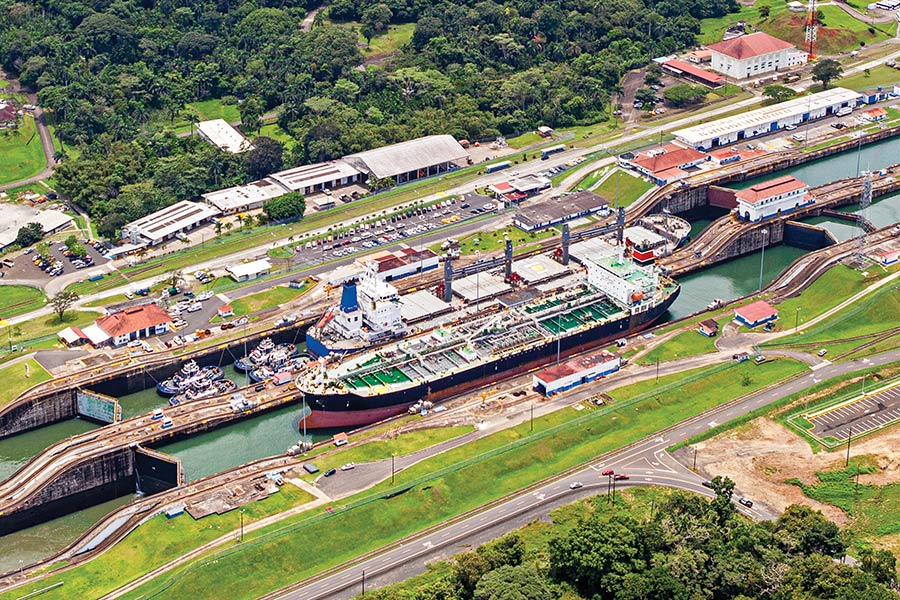
Below-normal precipitation can trigger a chain of consequences well beyond the watershed where it falls. During the 2023–2024 El Niño, accumulated precipitation in the Panama Canal’s watershed ran 25.6% below the 73-year average.2 Water levels fell by more than three meters, forcing the Panama Canal Authority to restrict vessel drafts and daily transits to conserve water. As a result, the authority reported a 21% decline in deep-draft transits from FY2023 to FY2024. In August 2026, the authority again introduced water-saving measures after precipitation fell below expectations.3 Those restrictions can reduce vessel loads and shipping capacity, raise transportation costs, and disrupt supply chains.4
In contrast, the same 2023–2024 El Niño that lowered Panama’s water levels brought record flooding to parts of East Africa. A joint post-disaster needs assessment by Somalia, the United Nations, the World Bank, and the European Union estimated $193.4 million in damages and losses across sixteen districts from Somalia’s 2023 Deyr floods alone.5 Such flooding can damage cargo, disrupt storage, and impair transportation infrastructure.
What this means for actuaries:
Before relying on such information, actuaries would need to confirm that it is relevant to the portfolio, adds information not yet reflected in claims data, and has a defensible relationship to estimates of ultimate loss. Once that relevance is established, scenario testing can show how reserve estimates respond to different assumptions about the duration and severity of disruption. This approach is consistent with Actuarial Standard of Practice No. 43, which directs actuaries to consider material external and changing conditions that may not be sufficiently reflected in historical data or existing assumptions.
Sources
- National Oceanic and Atmospheric Administration, Climate Prediction Center, “ENSO Diagnostic Discussion” and accompanying Official NOAA CPC ENSO Strength Probabilities, February 12, 2026; “ENSO Diagnostic Discussion,” August 13, 2026; National Oceanic and Atmospheric Administration, “Understanding El Niño & ENSO,” accessed August 31, 2026; and “June El Niño update: Damn the torpedoes, full speed ahead,” June 11, 2015.
- Autoridad del Canal de Panamá, “Más allá de la escasez: Cómo el Canal administra el desafío del agua” [Beyond scarcity: How the Canal manages the water challenge], October 2023.
- Panama Canal Authority, “Panama Canal Presents Financial Results for FY24 with a Focus on Sustainability and the Future,” October 25, 2024; and “Additional Measures to Address Reduced Precipitation in the Canal Watershed,” Advisory to Shipping No. A-29-2026, August 20, 2026.
- International Monetary Fund, “Drought in the Panama Canal Was Costly for Global Trade,” accessed September 2026.
- Federal Government of Somalia, Somalia Disaster Management Agency, in collaboration with the United Nations, World Bank, and European Union, “Somalia 2023 Deyr Floods: Rapid Post-Disaster Needs Assessment,” August 7, 2024.
- United Nations Environment Programme, Limiting Overshoot: Navigating Exceedance of 1.5°C and Pathways Towards Return, September 2, 2026.