
Developing News
What are the Odds? The Rise of Prediction Markets
n June 2024, the Commodity Futures Trading Commission (CFTC) made a major regulatory move: Its new rules reclassified certain types of online betting as legal financial instruments.1 This led to an explosion in prediction markets, such as Kalshi and Polymarket, generating $51 billion in gambling activity in 2025, and forecasted to grow to $240 billion by the end of 2026.2
How prediction markets work is relatively simple. Contracts are bought and sold with payoffs based on the outcome of unknown future events, typically a binary yes/no question, such as whether a football team exceeds a certain number of touchdowns. Shares are priced between $0.01 to $1 based on the market’s perceived probability of the outcome. If the ‘Yes’ share is currently at $0.75, that can be interpreted as the market estimates a 75% chance of the ‘Yes’ outcome to occur. The contract pays $1.00 if the specified event occurs, and $0 if it doesn’t. By aggregating these opinions and weighing them by bet sizes, the betting platform produces an odds ratio around a certain outcome that reflects the views of thousands of diverse participants.
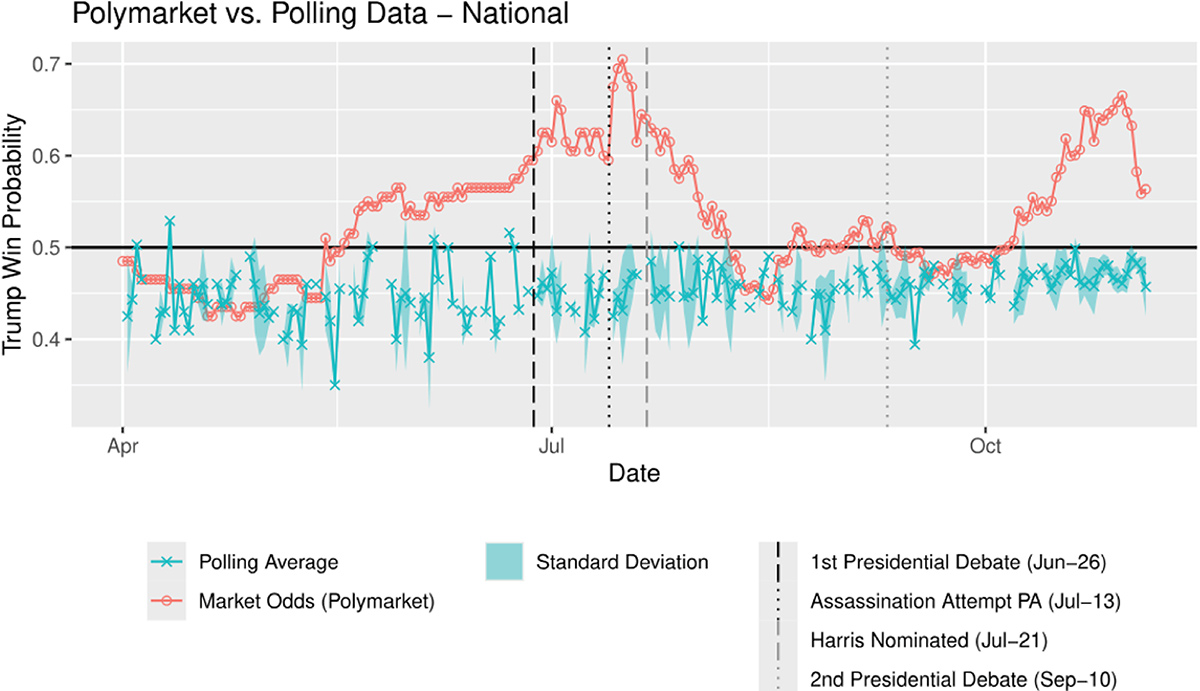
While 80% of prediction market is sports betting, these platforms have expanded into politics as well. The traditional method of political prediction, the poll, has often been criticized for biased sampling approaches or unclear question design. Prediction markets have the advantage of simplifying questions into a simple yes/no outcome while providing real-time updates to the election odds. Another strength is that prediction markets weigh individual sentiment by bet size, which may lead to a more accurate prediction. Perhaps the biggest difference between these two approaches is that a poll asks a sample of the electorate what they think, while a prediction market asks the bettor how they believe others think. This makes prediction market data an indirect type of consensus tool.
With prediction markets’ growing popularity comes growing risks. One issue is information asymmetry. In early 2026, a U.S. Special Forces member was caught using prediction markets to bet and win on a contract predicting that Venezuelan President Nicolas Maduro would be out of power by January 31, 2026. Insider information can skew the odds ratio, especially in smaller betting pools for specialized topics.
What this means for actuaries: