

It’s a Puzzlement
Unequal Coolant Tanks
aya runs a small pilot plant in which two well-stirred coolant tanks start at different temperatures. Tank A holds 2,000 liters at 90°C. Tank B holds 1,000 liters at 30°C. One pump sends coolant from A to B at 15 liters per minute, and a second pump sends coolant from B to A at the same 15 liters per minute, so both volumes stay fixed. The coolant has constant density and constant specific heat. The tanks are perfectly insulated: no heat is lost to the surroundings, and the pumps add none. Each tank remains well mixed.
(1) At the first instant, which tank’s temperature is changing faster — that is, which has the larger absolute rate of change and why?
(2) What common temperature do the two tanks approach?
(3) Find the exact time until the two temperatures differ by 1°C. A closed form is fine.
(4) Does tank A’s temperature ever fall to 50°C? If both flow rates are doubled to 30 liters per minute each way does the time in (3) exactly halve? Justify both answers.

The Phantom Current
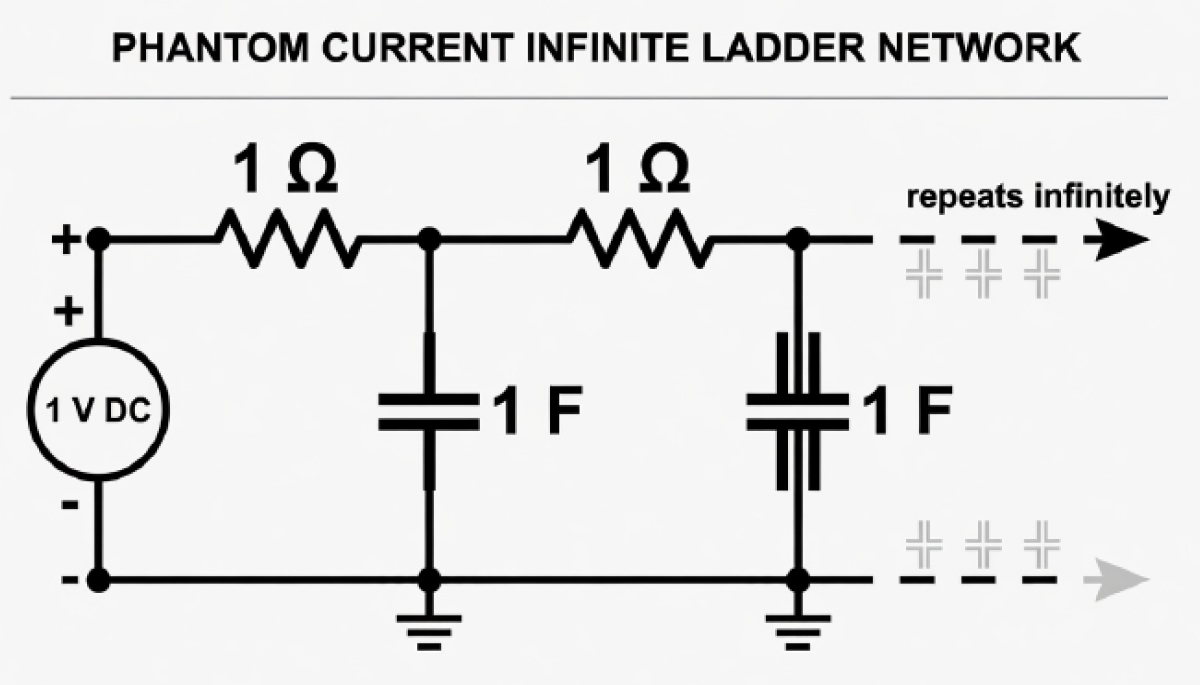
The striking feature of this infinite ladder is that the current drawn from the battery tends to zero, yet the total energy the battery ultimately delivers is infinite.
Number the shunt capacitors 1, 2, 3, … starting at the battery. Let v(n, t) be the voltage across the nth capacitor, and write v(0, t) = 1 for the ideal one-volt source, switched on at time t = 0. Every series resistor is 1 ohm and every shunt capacitor is 1 farad. The capacitors start uncharged, so v(n, 0) = 0 for every n ≥ 1. Kirchhoff’s laws then give the discrete diffusion equation
dvn/dt = vn−1 − 2 vn + vn+1, for n ≥ 1.
The voltage on the first capacitor can be written with modified Bessel functions of the first kind. Write In for the function of order n. Then
v1 (t) = 1 − e−2t [ I0(2t) + I1(2t) ].
The battery current is the current in the first resistor. With a one-volt source, that current is also the instantaneous power, in watts:
i(t) = 1 − v1 (t) = e−2t [ I0(2t) + I1(2t) ].
The energy delivered through time T, in joules, is therefore the integral of i(t) from 0 to T.
For any fixed order n and large t, In(2t) is asymptotic to exp(2t) / √(4πt). Orders 0 and 1 share that leading term, so their sum is asymptotic to exp(2t) / √(πt). The battery current therefore simplifies to
i(t) ~ 1 / √(π t).
Integrating that tail gives
E(T) ~ 2 √(T / π),
which diverges as T tends to infinity. The battery supplies infinite total energy. The current becomes arbitrarily small, but it decays only like 1/√t, too slowly for the integral to converge. That lingering draw is the phantom current.
v(n, t) = 1 − exp(−2t) [ I0(2t) + 2 · (the sum of Ik(2t) from k = 1 to n−1) + In(2t) ],
where the sum is empty when n = 1. An equivalent integral form is
v(n, t) = the integral from 0 to t of (n/τ) exp(−2τ) In(2τ) dτ.
At any finite time, only a finite depth of the ladder — a depth that grows like √t — has charged appreciably. Each individual capacitor approaches 1 volt, and the source current approaches 0. The network never settles into a finite-energy steady state, because that charged region keeps advancing down an infinite ladder, and the slow tail of the current keeps feeding it.
Solutions were submitted by Mercy Amalraj and Daniel Aarhus. Daniel Aarhus also submitted a solution for the May/June puzzle titled The Programmer’s Eternal Loop.