

An Uncertain Policy: Tariffs and the Future of P&C Insurance
arely has international trade policy created more friction for the U.S. P&C insurance industry than it does today. At the recent CAS 2026 Spring Meeting, Tom Roth and Phillip Kall, experts in actuarial analysis and reinsurance with Aon, presented a comprehensive study on how rapid shifts in U.S. tariff policy in 2025 directly influenced loss costs across multiple lines of P&C insurance. Their analysis provides a vital framework for insurance professionals to better understand how geopolitical “shocks” translate into inflationary pressure on claims.
Regulatory uncertainty
Ongoing debate on the tariffs’ legality has added to the confusion. Many of the 2025 tariffs, which were issued under the Trade Expansion Act and the International Emergency Economic Powers Act (IEEPA), were introduced to combat drug trafficking, penalize geopolitical policies, and address trade deficits. But because tariffs may apply only to legal, declared imports that pass through official customs, many were levied on specific trade categories, including steel, aluminum, copper, and automotive parts, with rates reaching as high as 145% for certain imports.
Aon’s study highlighted that foreign exporters generally do not lower their prices to offset tariffs. If they paid for tariffs, the prices of imported goods would decrease as tariff rates rise. The data indicates that import price indices remained elevated throughout 2025, confirming that tariffs create new costs for U.S. manufacturers and retailers. These costs eventually influence the consumer prices driving insurance claim severity.
Quantifying the inflationary shock
As such, Aon’s methodology deviated from a traditional one-off change approach that assumes a single, nonrecurring event or policy shift. Instead, the methodology accounted for rapidly changing tariffs and how businesses changed import patterns in response to policy shifts. This more dynamic methodology sourced White House executive orders, U.S. Census Bureau import values, and Personal Consumption Expenditure (PCE) monthly data to gauge inflationary costs.
The model divided inflation costs into goods inflation, service inflation, and wage inflation, with goods inflation reflecting the direct impact on pricing from the tariff itself. To calculate goods inflation, the study divided potential business reactions to the tariffs into four categories:
- Absorption: No change in prices. The business shoulders the cost.
- Pass-Through: The price increases by the same dollar amount as the tariff. The consumer shoulders the cost.
- Ratio Protection: The price increases by the same percentage amount as the tariff. The consumer will pay more than the full cost of the tariff.
- Partial Pass-Through: The business and the consumer split the cost. For example, a 70% pass-through would pass 30% of the cost to the business and 70% to the consumer.
Kall noted that tariffs often initially create a “goods shock,” during which the price of physical items rises. However, because the U.S. economy is largely service based, this inflation eventually flows into service costs. A critical component of the modeling is this “wage-price service spiral,” meaning that, as the cost of living increases, workers demand higher wages, which further drives up the cost of services.
Immediate market impacts
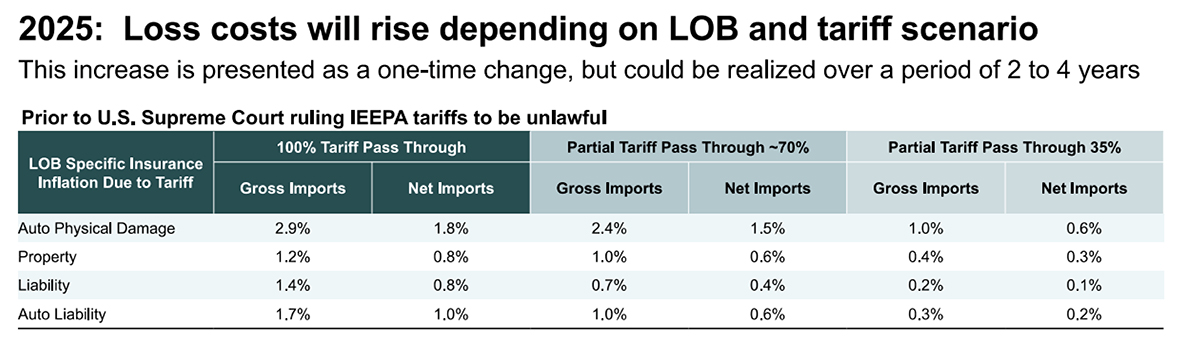
- Auto Physical Damage: This line saw the greatest impact, with an estimated post-tariff inflation rate of 5.7%. Vehicle replacement costs were the primary cost driver, due to the high concentration of imported parts and materials used in repairs.
- Property: Construction costs for residential and commercial property showed a 4% post-tariff inflation rate.
- Liability and Auto Liability: These lines are primarily influenced by healthcare and legal services rather than physical goods. However, the service spiral still generated inflation rates of 3.2% for liability and 3.5% for auto liability.
Kall added that these estimates are highly sensitive to pass-through assumptions. While some manufacturers and retailers initially absorbed costs to maintain market share, industry estimates suggest a 70% pass-through rate may be the ultimate outcome.
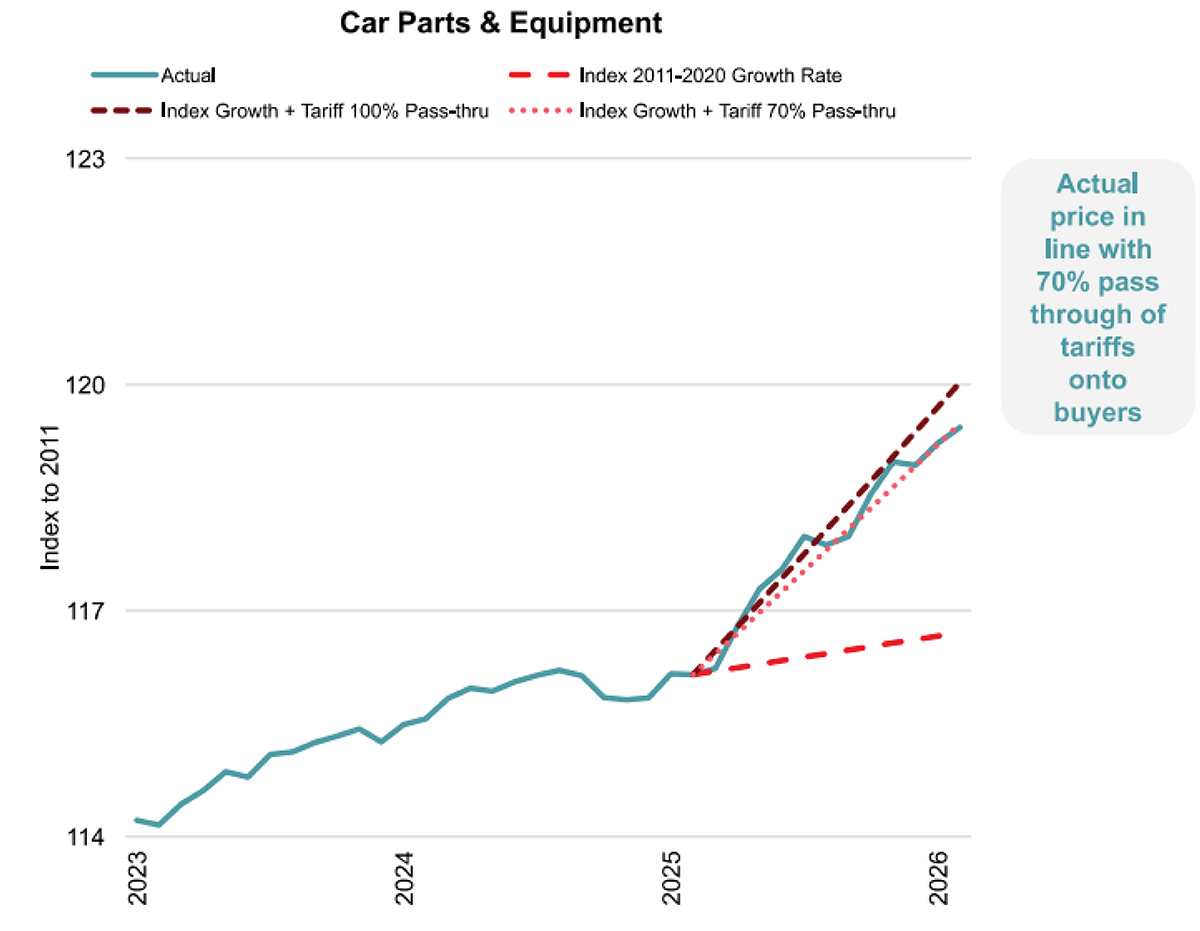
Despite not ranking among the top five U.S. exports, the automotive industry often sits at the center of the international trade landscape, driven by its household visibility, supply chain vulnerability, and velocity of trade. Kall explained that impacts on the automotive sector from the 2025 tariffs vary significantly based on how manufacturers balance domestic production with international supply chains. European luxury brands have faced substantial sales declines, leading some to invest billions in U.S. manufacturing to insulate themselves from future trade volatility. In contrast, certain Japanese makers have leveraged their existing U.S. infrastructure to maintain a competitive advantage.
U.S. producers are navigating billions in additional costs, and the market response has been immediate. In early 2025, vehicle supply declined sharply as consumers accelerated purchases to avoid anticipated price hikes. By the end of 2025, manufacturers reported significant earnings hits. To counter these costs, some manufacturers are keeping the base price stable by increasing delivery charges or resorting to “shrinkflation.” As Kall noted, cars don’t get smaller, but optional features and sensors can be reduced.
Strategic takeaways for insurance professionals
As legal challenges and pauses in trade policy occur, insurance professionals must also be equipped to adjust their scenarios in real time. Rather than pursue every possible scenario, insurers should look to maximizing their resources by remaining problem-focused and utilizing a best estimate approach. Roth emphasized that the goal isn’t to develop perfect parameters but to ensure that the core assumptions remain grounded in the current regulatory environment.
While the 2025 tariff shock was unique in its speed and scale, it serves as a strategic proof for how the insurance industry can better prepare against geopolitical risks. By monitoring the pass-through behavior of manufacturers and breaking down costs into goods, services, and labor, P&C professionals may be able to better anticipate how tariffs and supply-chain disruptions will broadly impact claim severity trends. As Roth and Kall emphasized, estimating the impacts of international trade policies on the insurance industry requires collaboration between actuaries and supply chain experts. A grounded, data-driven perspective is the best defense against economic uncertainty in an era where shifting trade dynamics have become another cost driver of insurance.