

It’s a Puzzlement
The Phantom Current
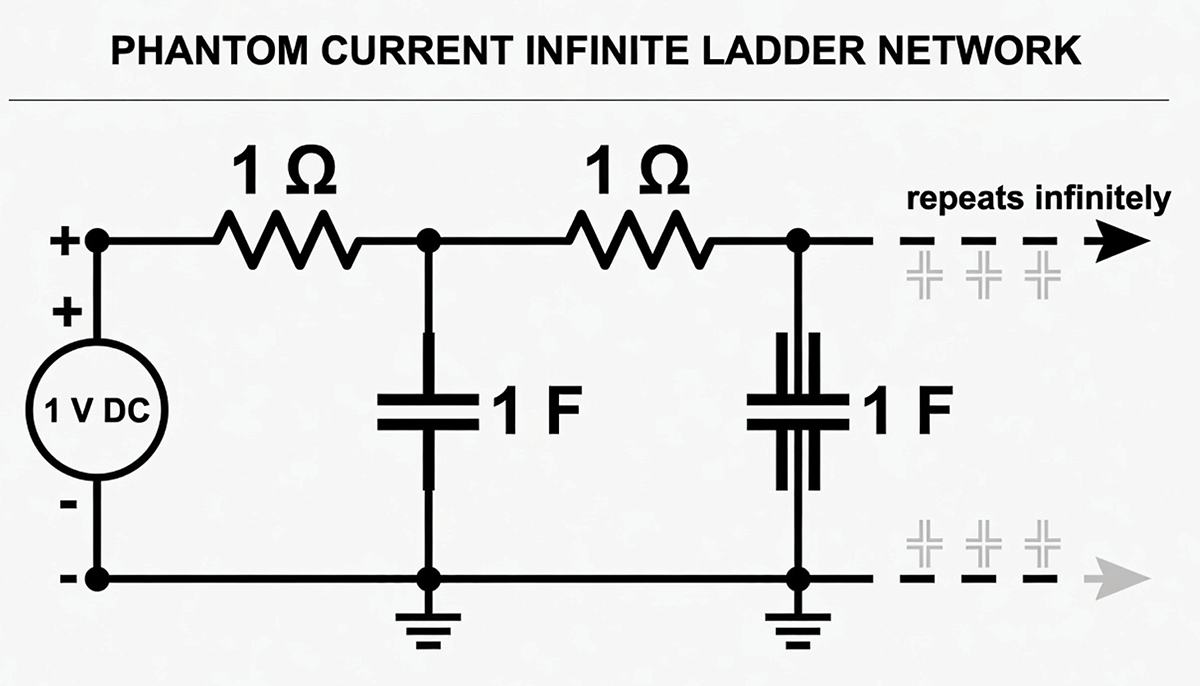
onsider an infinite ladder network where each section consists of a series resistor of exactly 1 ohm followed by a shunt capacitor of exactly 1 farad connected to ground. At time t = 0, a perfect 1-volt DC source is suddenly connected at the input end.
Despite the presence of infinitely many resistors and capacitors, is the total energy ultimately delivered by the battery finite or infinite? What is the exact total energy (in joules) that the battery supplies to the network as t approaches infinity?

Extra Credit
The Slippery Ring
I’ll assume that:
- “one position” refers to the starting locations of the N beads.
- the beads all jump at the same time (given that we “land on same position,” rather than “land on another bead”)
- That the # of positions must be odd. (Even numbers of positions would split the beads into distinct domains).
The Expected Time for the full ring appears to be:
E[T | N]=⅔ (N2-1)
E[T | N, fullset] = (2/3) (N^2 -1)
I verified this with exact formulas for small N, but only with simulation for larger N.
Hopefully, others have a simple reason for the general why!
More generally, if we remove K beads by going around and removing every other bead, we get the position with the lowest time for N-K remaining beads (which we define as the partial set):
E[T] = E[T|fullset] minus (2/3)(K*(K+1)*(K+2))/N
This yields zero for N-K=1.
Conversely, the slowest position with two beads (next to each other) on a large N ring takes (½)(N2-1). This is almost as bad as a full ring!
And EVERY position has an expected time that is an integral multiple of 4/N.
For the extra credit, the general formula gives E[T] ~ O(N2).