

erman actuary Paul Louis Riebesell proposed the popular “Riebesell form” for increased limit factors (ILFs) in the 1930s. It is still commonly used in the pricing of liability insurance and reinsurance around the world because it is convenient to be applied in practice and its parameter is easy to estimate. However, it is found that the Riebesell form of ILFs seem too heavy-tailed when they are utilized for some liability insurance lines in certain insurance markets. Here we propose a “modified Riebesell form” for ILFs that could fit the distribution of ILFs better in certain scenarios.
Loss Cost(Increased Limit) = Loss Cost(Basic Limit) *ILF((Increased Limit)/(Basic Limit)).
The essence of ILFs is to quantify the multiplicative relationship between the loss cost of basic limit and loss costs of different policy limits. Its definition can be formally given as follows:
ILF(M) = ILF((Increased Limit) / (Basic Limit)) = LAS(Increased Limit) / LAS(Basic Limit),
where M is the multiple between the increased limit and the basic limit, while LAS stands for Limited Average Severity defined as:
LAS(Limit) = E[min(Loss, Limit)] = ∫0LimitL * f(L)dL + Limit * [1 – F(Limit)].
Here, f(L) and F(L) are the probability density function and the cumulative distribution function (CDF) of the loss, respectively. In other words, the LAS for a given limit is the expected value of severity capped at the given policy limit.
ILF(M) = rlog2M,
where r is the Riebesell factor and M is the multiple between the increased limit and the basic limit as defined above.
The Riebesell factor r has a convenient property in the practice of liability insurance pricing. It is the relativity for the loss cost of two times the basic limit divided by the loss cost of the basic limit, and it is also equal to the relativity for the loss cost of four times the basic limit divided by the loss cost of two times the basic limit, and so on. Therefore, if the Riebesell form works well in practice, we can easily obtain the Riebesell factor by dividing the loss cost of two times the basic limit by the loss cost of the basic limit. The Riebesell form may be quite suitable for some heavy-tailed liability risks, such as the product liability line in the U.S.
However, for some other liability risks that are not so heavy-tailed, such as general liability insurance in China, the Riebesell form often does not work well. It is often identified that the relativity for the loss cost of four times the basic limit divided by the loss cost of two times the basic limit is smaller than that of the relativity for the loss cost of two times the basic limit divided by the loss cost of the basic limit. As well, the relativity for the loss cost of eight times the basic limit divided by the loss cost of four times the basic limit is usually smaller than that of the relativity for the loss cost of four times the basic limit divided by the loss cost of two times the basic limit, and so on. The exact rate of ILF decay may depend on different markets’ litigation environments and how quickly liability claims escalate through towers of coverage — and the Riebesell form is too inflexible to reflect this.
ILF(M) = Ms ,
where s=log2 r. This result follows from rearranging and rebasing terms in the formula from the previous section in the following manner:
ILF(M) = rlog2M = (r(lnM / ln2)) = (r(1 / ln2))lnM
= (e(ln r · (1 / ln2)))lnM = (e((lnM · ln r) / ln2))
= (elnM)(ln r / ln2)
= M(ln r / ln2) = Mlog2r = Ms
In order for the original Riebesell form to be applied, the loss cost of liability insurance must be heavy-tailed enough to satisfy the CDF:
F(x) = 1 – a * xs – 1,
where s must be less than 1 (that is, r <2) and x must be greater than a1 / (1 − s) for the purpose of F(x) being an effective CDF1. It could be proven that the expected value for this CDF does not exist. But in practice it is found that the above CDF is too heavy-tailed for some liability insurance products. Gary Venter identified this problem in one of his articles2, in which he regarded the above CDF as a kind of Pareto distribution with the shape parameter less than one. That kind of Pareto distribution is too heavy-tailed for some liability insurance products.
ILF(M) = r(log2M)α.
The modified Riebesell form has two parameters in which the parameter α controls the tail shape. Usually, α is less than one. Generally speaking, the original Riebesell form is a special case of the modified Riebesell form with the parameter α = 1. Under the modified Riebesell form, the tail of the increased limit factor distribution turns thinner as α decreases, as shown in Figure 1.
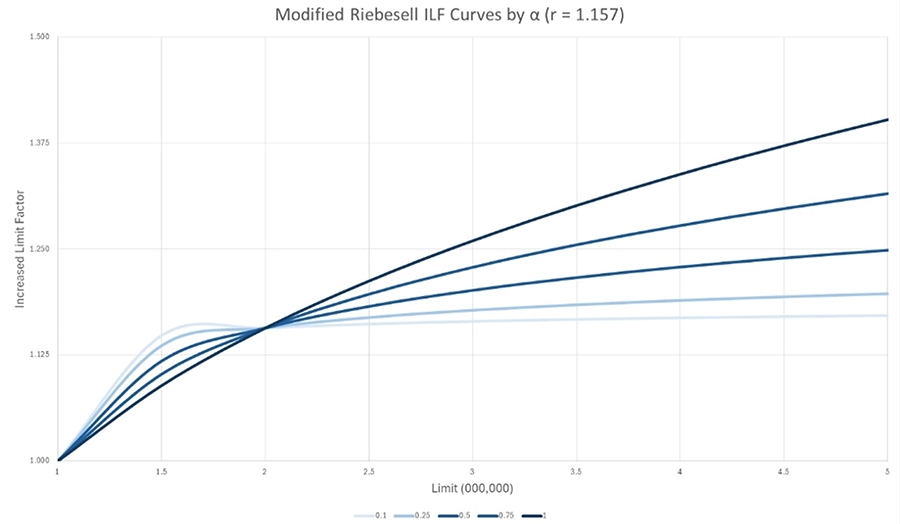
1.403 = 1.1572.322 = 1.157(log25)1.0
1.172 = 1.1571.088 = 1.157(log25)0.1
More information on selection of r = 1.157 is presented in the next section.
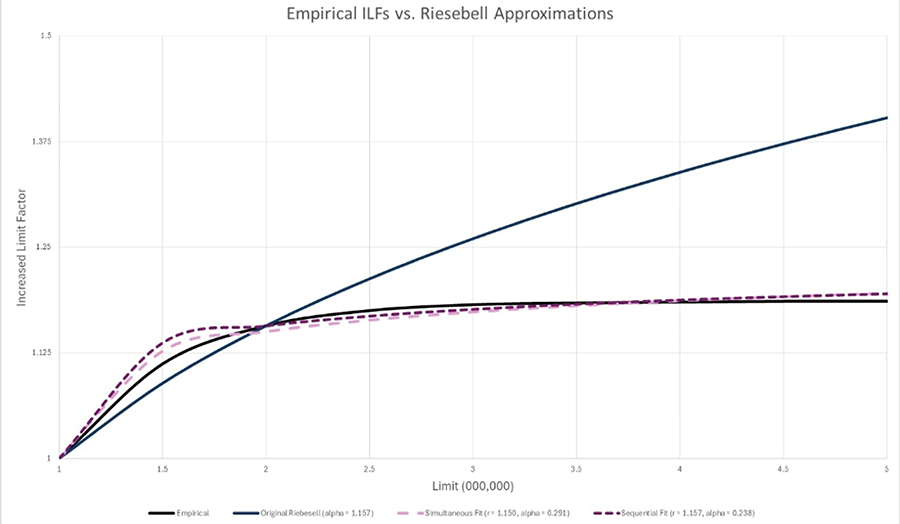
For illustration, we execute both approaches and compare their results to empirical ILFs for a simulated portfolio of Chinese general liability losses. For the original Riebesell form, we directly use the empirical ILF of two times basic limit as the estimate of the parameter r, which is 1.157 (which is the same value of r used to produce the curves in Figure 1). If we attempt to minimize the loss function of the mean squared error (MSE) for the modified Riebesell form, we obtain a fitted parameter α as 0.238.
- The derivation process of F(x): From ILF(M) = Ms = (E[min(X,M*B)])/(E[min(X,B)]) = (∫0M*B[1-F(x)]dx)/(E[min(X,B)]), we obtain ∫0M*B[1-F(x)]dx = E[min(X,B)] * Ms. Taking the derivative of M on both sides of the equation, we get 1-F(M*B) * B = E[min(X,B)] * s * Ms-1, which in turn implies F(M*B) = 1-E[min(X,B)] * s * B-1 * Ms-1. Let M = y/B, then F(M*B) = F(M*y/B) = F(y) = 1-E[min(X,B)] * s * B-1 * (y/B)s-1 = 1-E[min(X,B)] * s * B1-s * ys-1. Note that E[min(X,B)] * s * B1-s is a constant independent of y, so that is F(y) = 1-a*ys-1
- Gary Venter’s article may be found at http://www.garyventer.com/wp-content/uploads/2018/09/Venter-Pagliaccio-2005-Distributions-Underlying-Power-
Function-ILF-%E2%80%99-s-Riebesell-Revisited-.pdf